Merck Serono, the division for innovative prescription pharmaceuticals, is the largest division of the Merck Group, accounting for 67% of total group total revenues and 93% of revenues within the Pharmaceuticals business sector.
|
Merck Serono | Key figures – Q1 |
|
|
XLS |
|
|
|
|
|
|
EUR million |
1st quarter |
1st quarter |
Change |
|
Total revenues |
1,406.8 |
1,314.7 |
7.0 |
|
Gross margin |
1,186.5 |
1,126.2 |
5.4 |
|
Research and development |
–304.4 |
–271.9 |
12.0 |
|
Operating result |
178.0 |
175.7 |
1.3 |
|
Exceptional items |
– |
–70.0 |
– |
|
Free cash flow |
191.4 |
227.4 |
–15.8 |
|
Underlying free cash flow |
191.4 |
227.4 |
–15.8 |
|
ROS in % |
12.7 |
13.4 |
|
Business development
Merck Serono’s total revenues increased 7.0% to EUR 1,407 million in the first quarter of 2010 compared to EUR 1,315 million in the year-ago quarter, boosted by strong sales of Merck Serono’s two leading products – the biologic therapies Rebif®and Erbitux®. Royalty and commission income declined 27% to EUR 71 million as out-licensed products began losing patent protection in some countries. Due to the continued risk of potential currency losses in Venezuela, Merck has decided to post transactions from that country at the free market exchange rate.
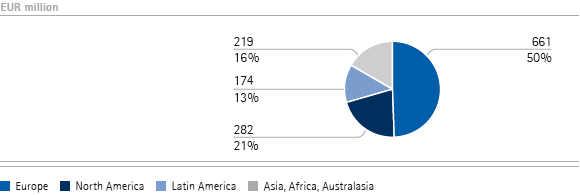
Merck Serono | Sales by Region – Q1
Due to higher R&D costs and other operating expenses, increased commission payments on sales of Rebif® in the United States and profit-sharing payments on Erbitux® in Japan, the division’s operating result rose 1.3% to EUR 178 million in the first quarter.
Therapeutic areas
Global sales of Rebif® for the treatment of relapsing forms of multiple sclerosis jumped 17% to EUR 429 million in the first quarter. Demand continued to improve but this quarter’s very large sales growth was mainly due to the fact that U.S. wholesalers received an extra 20 days supply of Rebif® and other products during March. This was because Merck’s EMD Serono subsidiary in the United States was converting to a new computer system during April and shipments would not be possible. Conversely, second-quarter sales will be lower in the United States.
Sales of the targeted cancer treatment Erbitux® continued to climb, increasing strongly by 19% in the first quarter to EUR 192 million due to higher sales in Japan and a double-digit increase in Europe. Erbitux® is now approved in 79 countries to treat colorectal cancer and in 76 countries to treat head and neck cancer. During March, Japanese regulators allowed the expanded use of Erbitux® for the treatment of first-line advanced or recurrent colorectal cancer in patients with KRAS wild-type tumors.
First-quarter sales of Gonal-f®, a recombinant hormone used in the treatment of infertility, increased by 3.8% to EUR 139 million.
Sales of the recombinant growth hormone Saizen® rose by 18% to EUR 54 million in the first quarter. Sales of Merck’s other growth hormone, Serostim®, increased by 19% in the first quarter.
Merck Serono’s classic pharmaceuticals continue to be significant contributors to the division’s overall sales.
Total sales of bisoprolol, including the branded Concor® products such as Lodoz® and Concor®COR decreased 2.1% to EUR 97 million in the first quarter. Total sales of the Glucophage® (metformin) franchise of oral antidiabetic products increased 9.7% to EUR 81 million in the first quarter due to strong performances in Latin America and Asia. This established product and its newer versions such as the recently launched Glucophage® Powder, remain the worldwide “gold standard” for first-line treatment of type 2 diabetes.
Sales of thyroid medicines such as Euthyrox® increased by 8.3% to EUR 39 million in the first quarter, due to strong demand in Europe and Latin America. Merck’s products are the most prescribed medicines worldwide for thyroid disorders.
Research and development
Merck Serono research and development costs rose to EUR 304 million, a 12% increase compared to the first quarter of 2009 but in line with subsequent quarters of 2009. The division’s R&D costs have risen due to the large number of expensive, late-stage clinical trials that are necessary to demonstrate the safety and efficacy of medicines before they can be approved by health authorities.
Ground was broken in Darmstadt in February for a EUR 39 million building to house Merck Serono’s non-clinical pharmaceutical development activities, including space for a pilot production plant and laboratories.
Merck’s application for marketing authorization of its new multiple sclerosis treatment Cladribine Tablets is currently under review by to the European Medicines Agency (EMA) and Merck continues to expect the Committee for Medicinal Products for Human Use (CHMP) opinion by the third quarter. The company continues to work with the U.S. Food and Drug Administration (FDA) to address issues that led the FDA to issue a refuse to file letter for the Cladribine Tablets application in November. In the meantime, results from the CLARITY Phase III trial, which showed that Cladribine Tablets met the two-year primary endpoint of reducing the relapse rate in patients with relapsing-remitting multiple sclerosis, was published in January in The New England Journal of Medicine. Also, new data from CLARITY was presented in April 2010 at the 62nd Annual Meeting of the American Academy of Neurology.
Merck has temporarily suspended the clinical program for its therapeutic cancer vaccine Stimuvax® (BLP25 liposome vaccine) in all recruiting studies worldwide as a result of a suspected unexpected serious adverse reaction (SUSAR). This decision was taken in alignment with the FDA clinical hold placed on the Investigational New Drug (IND) application for Stimuvax®. A patient participating in a Phase II exploratory clinical trial with Stimuvax® in patients with multiple myeloma developed encephalitis and subsequently died.