Merck Serono, the division for innovative prescription pharmaceuticals, is the largest division of the Merck Group, accounting for 66% of total Group revenues and 93% of revenues within the Pharmaceuticals business sector.
|
Merck Serono | Key figures |
|
|
|
XLS |
|
|
|
|
|
|
|
EUR million |
2nd quarter |
Change |
Jan.–June |
Change |
|
Total revenues |
1,450.5 |
10.0 |
2,857.3 |
8.5 |
|
Gross margin |
1,218.8 |
10.7 |
2,405.3 |
8.0 |
|
Research and development |
–296.1 |
–2.0 |
–600.6 |
4.6 |
|
Operating result |
163.6 |
31.2 |
341.6 |
13.7 |
|
Exceptional items |
– |
– |
– |
– |
|
Free cash flow |
257.5 |
83.4 |
448.9 |
22.1 |
|
Underlying free cash flow |
257.5 |
83.4 |
448.9 |
22.1 |
|
ROS in % |
11.3 |
|
12.0 |
|
Business development
Merck Serono’s total revenues increased 10% to EUR 1,451 million in the second quarter of 2010 compared to EUR 1,319 million in the year-ago quarter, boosted by strong sales of Merck Serono’s two leading products – the biopharmaceutical therapies Rebif® and Erbitux®. Regionally, sales rose significantly in China, Japan and Latin America. Positive currency effects of 3.6% also contributed to the increase. First-half revenues rose 8.5% to EUR 2,857 million.
Royalty and commission income rose in the second quarter by 30% to EUR 101 million due to first-quarter adjustments, positive currency effects and milestone payments.
Merck Serono | Sales by region – Q2
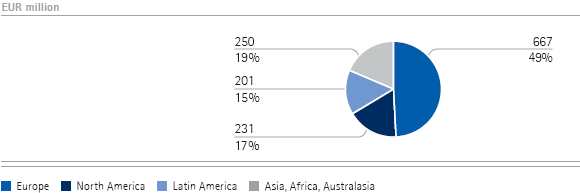
The division’s gross margin rose by 11% to EUR 1,219 million in the second quarter. Marketing and selling costs rose 12% during the second quarter, influenced by pre-launch costs for Cladribine Tablets for the treatment of multiple sclerosis. Royalty and commission expenses were up 14% in the quarter due to higher sales of Erbitux®, especially in Japan, and higher royalty income.
The division’s quarterly charge for amortization of intangible assets from the 2007 acquisition of Serono remained at EUR 143 million in the second quarter of 2010, as in the corresponding quarter last year.
Despite higher marketing and selling costs, an improved gross margin resulted in a 31% increase in the second-quarter operating result to EUR 164 million. In the first half of 2010, the operating result rose 14% to EUR 342 million.
The division’s second quarter ROS was 11.3% compared to 9.5% in the year-ago quarter. Core ROS, which Merck defines as excluding Serono-related amortization of intangible assets, was 21.1% in the second quarter of 2010 compared to 20.6% in the year-ago quarter. Free cash flow was EUR 258 million in the second quarter of 2010 compared to EUR 140 million in the year-ago quarter.
Therapeutic areas
Royalty and commission income rose in the second quarter by 30% to EUR 101 million due to first-quarter adjustments, positive currency effects and milestone payments.
Global sales of Rebif® for the treatment of relapsing-remitting forms of multiple sclerosis rose 4.0% to EUR 402 million in the second quarter. This was slightly less than the EUR 429 million booked in the first quarter due to the fact that U.S. wholesalers received an extra 20 days supply of Rebif® and other products during March. Merck’s United States subsidiary EMD Serono implemented a new computer system in April, which meant shipments were not possible then.
Sales of the targeted cancer treatment Erbitux® continued to climb, increasing by 23% in the second quarter to a record EUR 210 million following a 19% increase to EUR 192 million in the first quarter. It has only been two years since the announcement that about two-thirds of colorectal cancer patients carry the KRAS wild-type gene and can benefit from treatment with Erbitux®. A global survey now shows that 66% of colorectal cancer patients are being tested for KRAS, indicating that doctors want to use tailored treatments such as Erbitux®.
Second-quarter sales of Gonal-f®, a recombinant hormone used in the treatment of infertility, increased by 6.9% to EUR 122 million.
Merck Serono’s primary care products continue to contribute significantly to the division’s overall sales.
Total sales of bisoprolol, including the branded Concor® products such as Lodoz® and Concor®COR decreased 3.2% to EUR 108 million in the second quarter. Total sales of the Glucophage® (metformin) franchise of oral antidiabetic products rose 3.9% to EUR 81 million in the second quarter.
Sales of thyroid medicines such as Euthyrox® jumped by 21% to EUR 47 million in the second quarter, due to the growing awareness of the importance of a properly functioning thyroid.
Research and development
Merck Serono research and development costs declined by 2.0% to EUR 296 million compared to a slightly higher second quarter in 2009 of EUR 302 million. First-half R&D expenses rose by 4.6% to EUR 601 million. The division’s R&D costs continue to be just over 20% of total revenues due to the large number of expensive, late-stage clinical trials.
In July of this year, Russian health authorities granted marketing authorization for Cladribine Tablets for the treatment of relapsing-remitting multiple sclerosis. This was the first approval in the world of an oral treatment for multiple sclerosis. Merck’s application for marketing authorization of Cladribine Tablets is under review by the European Medicines Agency (EMA) and Merck continues to expect the Committee for Medicinal Products for Human Use (CHMP) opinion in September. During the second quarter, the company resubmitted its New Drug Application (NDA) to the U.S. Food and Drug Administration (FDA) for Cladribine Tablets after receiving a refuse to file letter on the original submission last November. In July, the FDA granted priority review to Cladribine Tablets for the treatment of relapsing remitting multiple sclerosis. A decision by the FDA is expected in Q4 2010.
The clinical program for the therapeutic cancer vaccine Stimuvax® (BLP25 liposome vaccine) in patients with non-small cell lung cancer resumed in June. Trials were halted world-wide in March in alignment with the FDA clinical hold placed on the Investigational New Drug (IND) application for Stimuvax® as a result of a suspected unexpected serious adverse reaction (SUSAR). In July, Merck decided to close the Phase III STRIDE trial of Stimuvax® in breast cancer patients.