Merck Serono, the division for innovative prescription pharmaceuticals, is the largest division of the Merck Group, accounting for 57% of total Group revenues and 92% of revenues within the Pharmaceuticals business sector.
|
Merck Serono | Key figures |
|
|
|
XLS |
|
|
|
|
|
|
|
EUR million |
3rd quarter |
3rd quarter |
Jan.–Sep. |
Jan.–Sep. |
|
Total revenues |
1,393.5 |
1,318.6 |
4,250.7 |
3,952.3 |
|
Gross margin |
1,199.8 |
1,099.4 |
3,605.1 |
3,327.0 |
|
Research and development |
–279.6 |
–293.2 |
–880.2 |
–867.4 |
|
Operating result |
209.5 |
123.4 |
551.1 |
423.8 |
|
Exceptional items |
– |
– |
– |
–70.0 |
|
Free cash flow |
410.4 |
313.2 |
859.3 |
681.0 |
|
Underlying free cash flow |
410.4 |
313.2 |
859.3 |
681.0 |
|
ROS in % |
15.0 |
9.4 |
13.0 |
10.7 |
Business development
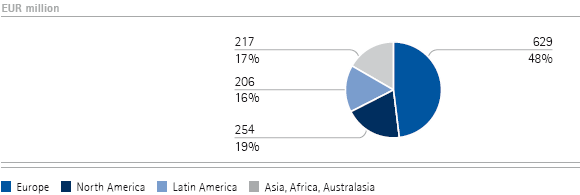
Merck Serono’s total revenues increased 5.7% to EUR 1,393 million in the third quarter of 2010 compared to EUR 1,319 million in the year-ago quarter, boosted by sales of Merck Serono’s two leading products – the biological therapies Rebif®and Erbitux® – and a 4.1% positive currency effect. Regionally, sales rose significantly in Japan, Latin America and North America. New German health care reform legislation took effect in August, contributing to a decline in sales in Merck’s home market. Sales in China were minimal during the third quarter as Merck deferred sales to local distributors due to the establishment of its own trading company in China and the resulting change in inventory policy. Sales should return to normal levels in the fourth quarter.
Royalty and commission income rose in the third quarter by 5.8% to EUR 88 million.
Merck Serono | Sales by region – Q3
The division’s gross margin rose by 9.1% to EUR 1,200 million in the third quarter as production costs declined. Marketing and selling costs rose 9.7% during the third quarter. Royalty and commission expenses were up 8.0% in the quarter due to higher third-party sales of Erbitux®, especially in Japan, and higher royalty income that leads to higher royalty payments.
The division has been receiving payments from Venezuela for 2009, albeit the country’s lower official rate, and booked the funds under other operating expenses and income. As it was unclear if these payments would ever be collected, the division had booked a provision in the third quarter of 2009.
The division’s charge for amortization of intangible assets from the 2007 acquisition of Serono amounted to EUR 148 million in the third quarter of 2010, similar to previous quarters.
With an improved gross margin and lower R&D costs the division’s third-quarter operating result jumped 70% to EUR 210 million from EUR 123 million in the year-ago quarter, which was affected by the
The division’s third-quarter ROS was 15.0% compared to 9.4% in the year-ago quarter. Core ROS, which excludes Serono-related amortization of intangible assets, was 25.7% in the third quarter of 2010 compared to 20.5% in the year-ago quarter. Free cash flow was EUR 410 million in the third quarter of 2010 compared to EUR 313 million in the year-ago quarter.
Therapeutic areas
Global sales of Rebif® for the treatment of relapsing-remitting forms of multiple sclerosis rose 6.8% to EUR 407 million in the third quarter.
Sales of the targeted cancer treatment Erbitux® continued to climb, increasing by 17% in the third quarter to EUR 207 million.
Third-quarter sales of Gonal-f®, a recombinant hormone used in the treatment of infertility, increased by 3.9% to EUR 115 million, damped by the lack of sales in China, a major market for this product.
Sales of the recombinant growth hormone Saizen® for growth hormone deficiency rose by 17% to EUR 56 million in the third quarter. Sales of Merck’s other leading growth hormone, Serostim® increased by 6.5% in the quarter.
Merck Serono’s primary care products continue to contribute significantly to the division’s overall sales. Total sales of the beta blocker bisoprolol, including the branded Concor® products such as Lodoz® and Concor®COR decreased 19% to EUR 84 million in the third quarter. Total sales of the Glucophage® (metformin) franchise of oral antidiabetic products rose 3.3% to EUR 79 million in the second quarter. Sales of thyroid medicines such as Euthyrox® were little changed at EUR 41 million in the third quarter.
Research and development
Research and development spending by Merck Serono declined by 4.6% to EUR 280 million compared to EUR 293 million in the year-ago quarter. The division’s R&D costs remained at about 20% of revenues due to the large number of expensive, late-stage clinical trials.
In July 2010, Russian health authorities granted marketing authorization for Cladribine Tablets for the treatment of relapsing-remitting multiple sclerosis. The Australian health authorities followed with a similar approval in September.
Merck’s New Drug Application (NDA) for Cladribine Tablets was accepted in July by the U.S. Food and Drug Administration (FDA) and granted a priority review. However, the Committee for Medicinal Products for Human Use (CHMP) of the European Medicines Agency (EMA) issued a negative opinion regarding the marketing authorization application for Cladribine Tablets in September due to what it perceived as an unfavorable benefit-risk ratio. Merck has announced its intention to appeal that decision.