
EBITDA pre one-time items is the main profitability measure of ongoing operational performance used internally and externally. It excludes from the operating result depreciation and amortization in addition to one-time items largely related to restructuring measures. It allows for an understanding of the underlying operational performance of the Merck Group and the four divisions.
Merck Group | EBITDA pre one-time items and growth by quarter1
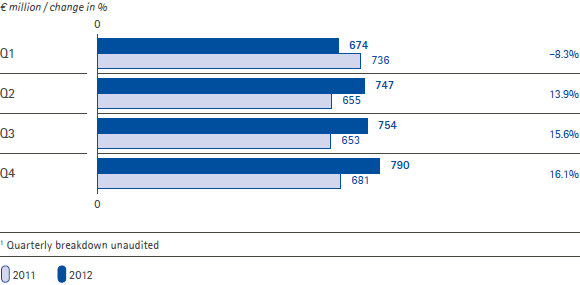
Apart from EBITDA pre, a new cash flow performance indicator was introduced in 2012 to be used as the second key indicator for internal target agreements and individual incentive plans. Broken down to the divisional level, it sums up EBITDA pre and main cash items such as investments in property, plant, equipment and software as well as changes in inventories and changes in trade accounts receivable, all of which are under full control of the individual businesses. Consequently, increases in inventory and trade accounts receivable have an adverse impact on individual incentive plans, while conversely decreases are positively incentivized. The introduction of this performance indicator has led to considerable improvements in cost awareness as well as reduced working capital requirements.
In February 2012, Merck announced its global efficiency program, which spans all regions and businesses. During the year, more than 100 individual initiatives were implemented in countries such as Spain, Italy, and the United Kingdom. For the German operations, which account for more than one-quarter of all Merck employees, an agreement was signed in September 2012 with the employee representatives aiming to eliminate around 1,100 of the 10,900 positions by the end of 2015. By making the reductions in a socially responsible manner, mainly through voluntary leaver and partial retirement programs across all divisions and functions, Merck will refrain from forced redundancies until the end of 2017, with the exception of possible site closures and transfers that are still being assessed. Further cost savings will be realized by a reduction in personnel costs as the result of a realignment of the compensation system. Merck plans to invest a total of at least € 250 million in Darmstadt and other sites within Germany during the next two years.