Merck Serono, the Group’s specialty biopharmaceutical division, accounted for 55% of Group sales in the first quarter of 2012.
The division’s first-quarter total revenues rose 4.8% to € 1,495 million in 2012 compared to € 1,427 million in the first quarter of 2011. Sales for the division increased 5.4% to € 1,417 million compared to € 1,345 million in the year-ago quarter. This performance reflected organic sales growth of 4.1% and a positive benefit from foreign exchange rates of 1.2%. The drivers of Merck Serono’s first quarter sales increase included strong performance from its Fertility, Endocrinology, and CardioMetabolic Care & General Medicines businesses. All three saw meaningful growth from the Emerging Markets in the quarter. The division also generated growth from its two largest products, Erbitux® and Rebif®, aided by a net pricing benefit.
| XLS |
|
Merck Serono | Key figures – Q1 | |||
|
|
|
|
|
|
|
|
|
|
|
€ million |
Q1 – 2012 |
Q1 – 2011 |
Change |
|
Total revenues |
1,495.3 |
1,427.2 |
4.8% |
|
Sales |
1,417.2 |
1,344.9 |
5.4% |
|
Operating result (EBIT) |
152.0 |
152.5 |
–0.3% |
|
Margin (% of sales) |
10.7% |
11.3% |
|
|
EBITDA |
383.8 |
402.4 |
–4.6% |
|
Margin (% of sales) |
27.1% |
29.9% |
|
|
EBITDA pre one-time items |
393.5 |
401.4 |
–2.0% |
|
Margin (% of sales) |
27.8% |
29.8% |
|
Royalty, license and commission income declined by 5.0% to € 78 million in the first quarter compared to € 82 million in the year-ago quarter. The decline was due to a one-time milestone payment of € 10 million in the first quarter of 2011 related to the FDA approval of the antidepressant vilazodone, which was previously outlicensed by Merck Serono.
The division’s production costs rose 33% in the first quarter due to higher start-up costs for the new biotech production plant in Corsier-sur-Vevey (Switzerland). In addition, production costs in Q1 2011 were lower due to positive manufacturing variances. This led to a gross profit of € 1,224 million. The gross margin (as a percentage of sales) fell to 86.3% from 90.9% in the year-ago quarter.
The division lowered promotional spending, which helped marketing and selling costs to decline by 5.3% to € 332 million. Royalty, license and commission expenses rose 8.4% to € 115 million, primarily due to higher sales for Rebif® in the United States.
Research and development spending by Merck Serono declined slightly to € 303 million in the first quarter. This line item remains at a high level due to several expensive late-stage clinical trials.
Amortization of intangible assets at Merck Serono decreased in the first quarter by 17% to € 165 million from € 199 million as the year-ago quarter was affected by a € 50 million impairment for cladribine.
Other operating expenses (net) doubled compared to last year’s first quarter to € 96 million mainly due to receivable allowances and restructuring costs.
The reported operating result (EBIT) of Merck Serono declined slightly to € 152 million from € 153 million as higher sales could not offset higher operating expenses.
The division’s EBITDA pre declined 2.0% to € 394 million in the first quarter of 2012, resulting in a margin (as a percentage of sales) of 27.8%, compared to € 401 million in the year-ago quarter, with a margin of 29.8%.
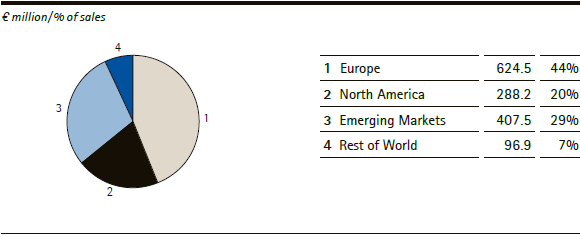
From a geographic perspective, Merck Serono reported an organic sales decline of 3.1% in Europe during the first quarter while North America generated organic sales growth of 8.2%. The Emerging Markets organic growth was 11%, and the Rest of the World reported organic growth of 20%.
Merck Serono | Sales by region – Q1
Global sales of Merck’s largest single product, Rebif® for the treatment of relapsing forms of multiple sclerosis (MS), rose 2.7% organically to € 430 million in the first quarter or 4.5% on a nominal basis. The increase is mainly due to price increases in the United States in the first quarter of 2012 and in June 2011. Sales increased organically in the Emerging Markets by 31%, boosted by a marked increase in health care spending in Venezuela.
A difficult environment in Europe due to cost-containment measures resulted in an organic sales decline in that region. In January 2012, Merck Serono received approval from the European Commission for the extension of the drug’s indication to include patients who have experienced a single demyelinating event, an early sign of MS, and who are at risk of converting to MS. This approval is for the use of Rebif® 44 micrograms three times weekly and is not applicable in the United States.
| XLS |
|
Merck Serono | Growth components by region – Q1 | |||||
|
|
|
|
|
|
|
|
|
|
|
|
|
|
|
€ million/change in % |
Sales |
Organic growth |
Exchange rate effects |
Acquisitions/ |
Reported |
|
Europe |
624.5 |
–3.1% |
–0.1% |
– |
–3.2% |
|
North America |
288.2 |
8.2% |
3.8% |
– |
12.0% |
|
Emerging Markets |
407.5 |
10.7% |
1.1% |
– |
11.9% |
|
Rest of World |
96.9 |
19.6% |
4.3% |
– |
23.9% |
Sales of the targeted cancer treatment Erbitux® increased 1.3% on an organic basis to € 214 million in the first quarter of 2012. Sales stayed relatively flat (+0.2% organically) in Europe, where stronger UK sales driven by NICE reimbursement were offset by cost-containment measures in other countries. Sales in Emerging Markets grew 7.1% organically with good sales reported from Brazil. Sales in Rest of World decreased organically by 3.2%. A strong performance in Australia was offset by a sales decline in Japan due to growing competition.
| XLS |
|
Merck Serono | Major products by region, organic growth rates – Q1 | ||||||
|
|
|
|
|
|
|
|
|
|
|
|
|
|
|
|
|
€ million/ |
Sales |
Europe |
North America |
Emerging |
Rest of World |
Total |
|
Rebif® |
429.8 |
–6.6% |
7.5% |
31.2% |
–7.8% |
2.7% |
|
Erbitux® |
213.6 |
0.2% |
– |
7.1% |
–3.2% |
1.3% |
First-quarter sales of Gonal-f®, a recombinant hormone used in the treatment of infertility, improved markedly, rising 13% on an organic basis to € 152 million. The introduction of a new line of ready-to-use injection pens helped boost sales. Merck Serono’s entire Fertility business performed strongly in the first quarter, with organic sales growth of 15% driven by demand in the United States, Europe, Australia, Asia and Africa.
The division’s Endocrinology business also continued its robust growth in the first quarter, posting sales of € 92 million, which represented an organic sales growth of 12%. Sales of the recombinant growth hormone Saizen® for the treatment of growth-hormone deficiency were € 59 million, representing a 6.9% organic sales growth in the quarter.
Kuvan®, which was launched in 2009, continues to grow rapidly. This product is the first and only prescription drug approved in Europe for the treatment of hyperphenylanlaninemia (HPA) due to phenylketonuria (PKU) in patients over the age of 4 or due to tetrahydrobiopterin (BH4) deficiency, two rare genetic diseases.
Merck Serono’s CardioMetabolic Care & General Medicines products posted a 1.5% organic sales growth. This business includes the branded Concor® (bisoprolol) beta-blocker products, such as Lodoz® and Concor®COR; thyroid medicines such as Euthyrox®, and the Glucophage® (metformin) franchise of oral antidiabetic products.
On February 3, Merck announced a global agreement with Threshold Pharmaceuticals, Inc., USA, to co-develop and commercialize TH-302, Threshold’s small molecule hypoxia-targeted drug. TH-302 is currently being investigated in a global Phase III clinical trial in patients with soft tissue sarcoma as well as in Phase 1 trials in other solid tumors and hematological malignancies. On February 21, Threshold announced that a Phase II clinical trial evaluating TH-302 in patients with first-line advanced pancreatic cancer plus chemotherapy achieved its primary endpoint, with a 63% improvement in progression-free survival.