
An era of endless opportunities. Whether it comes to printable electronics or labels that communicate, Merck is on a journey to understand new needs – and is therefore taking its customers along with it.
They’re becoming increasingly flatter, more powerful and ubiquitous. Displays are already playing a key role in communication today. And that is just the beginning of a dynamic process that is fundamentally changing the way we communicate. With our innovations, we are driving this development in close cooperation with our customers.
- Interview with Walter Galinat and Roman Maisch
- At a glance
- Pigments and additives for the printing, plastics and coatings industries
- Cosmetics, food and pharmaceuticals
- OLED
- Lighting & Photovoltaics
- Electronic Materials
- Performance Solutions
- Display materials
Interview with Walter Galinat and Roman Maisch
Passive viewing is a thing of the past – the future is about interaction. Thanks to innovative liquid crystals from Merck, displays are capable of far more than simply glowing in a rainbow of colors.
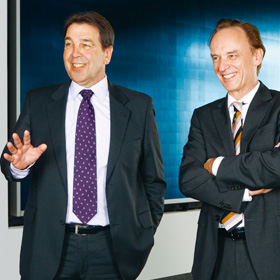
Walter Galinat, President and CEO of Performance Materials, and Roman Maisch, responsible for Liquid Crystals Marketing & Sales
“The future is flat.”
Mr. Galinat, Mr. Maisch: The earth may be round, but your world is flat, isn’t it?
Galinat: If you’re referring to what I do professionally, then yes.
Maisch: And if I may add, it’s getting flatter all the time (laughs).
Why is that?
Galinat: Because displays are flat and increasingly becoming our number one communication tool. We live in an age of ubiquitous interaction, which is both a tremendous opportunity and an enormous challenge. With materials for printed electronics, organic LEDs and organic photovoltaics, we have the possibility to create new applications and new benefits. But we need to take our customers with us on this journey.
And where is the journey heading?
Maisch: Toward the cities of tomorrow with smart windows or facades that speak, for instance. Toward autonomous driving or yoghurt cup labels that communicate. So far, we’ve mainly been talking to our customers about the technical aspects of displays, discussing topics such as curvature, flexibility or switching times. But technical feasibility is just one side of the coin. Together with our customers, we also need to look into the future so as to understand new needs even better than before.
60%
Global market share as a supplier of liquid crystals
In other words, working with customers to achieve advances?
Galinat: Yes. As the market and technology leader, we are expected to think further down the line and to launch new products onto the market. This starts with innovative products, but does not stop there. The aim is also always to expand our knowledge of both technology and society.
So the Performance Materials division is becoming a type of think tank?
Galinat: The right way to put it is: we’re thinking ahead. But that’s something we always do, keeping an eye on what is technically feasible and what will benefit our customers. We’re constantly tapping into greater and deeper expertise and sharing this knowledge with our customers. This is precisely the principle behind our Displaying Futures symposium, which took place in South Korea in 2013: using unexpected benefits to surprise and then work with customers to develop exactly what they’re looking for. For this purpose, we’re bringing display manufacturers together with architects, designers and trend researchers, an approach that enables us to look at the entire value chain.
Is that how you’re creating new markets?
Maisch: Well, it’s how we’re helping to shape the markets that are so important to us. Here’s an example: The question as to how we’ll be able to apply organic light-emitting diodes, or OLEDs, in the future can no longer be answered in the laboratory alone. For this purpose we need to get out and talk to our customers, think outside the box, and offer inspirational new ideas.
Galinat: Markets don’t fall from heaven; they are created. This requires patience, sometimes for years or even decades. To us it’s clear that the future is flat – and it will entail applications that we can’t even begin to imagine today.
Expected market share of OLED and LCD televisions
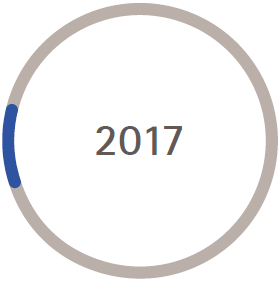
93% LCD televisions
7% OLED televisions
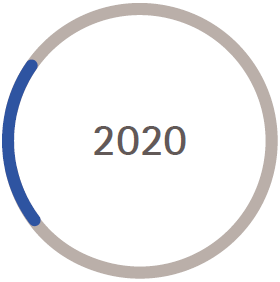
80% LCD televisions
20% OLED televisions
At a glance
Performance Materials
The division consists of the Liquid Crystals, Pigments & Cosmetics and Advanced Technologies business units. Its market-leading products include liquid crystals for LCD televisions and other displays as well as functional fillers and effect pigments.
The business units
Pigments & Cosmetics
Advanced Technologies
Liquid Crystals
With the broadest offering in the industry, the product portfolio of our Liquid Crystals business unit is tailored to match the individual requirements of the full range of LCDs, from small displays in smartphones to ultra-large televisions.
Business figures
Sales
€ 1,642,092,500
EBITDA pre
€ 779,704,313
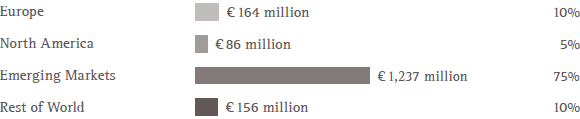
Sales by region
Microcosmos
OLED
With its livilux® range, Merck offers innovative materials for organic light-emitting diodes (OLEDs). In displays, OLEDs are responsible for brilliant colors, good contrast, fast switching times and low power consumption.
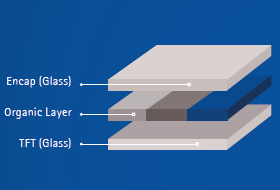
01 Structure
OLEDs consist of organic, semiconductive small molecules, which are deposited onto a glass substrate between conductive electrodes.
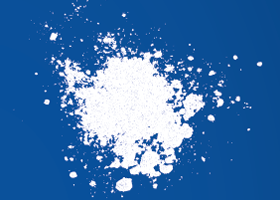
02 livilux®
The livilux® range includes small molecules for evaporation processes and soluble material systems for printing processes.
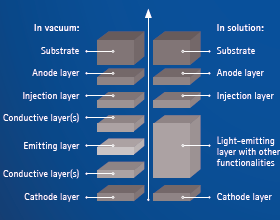
03 Functionality
How an OLED works When voltage is applied, electrons and electron holes recombine to form excitons. The molecular structure of the emitter materials determines the color.
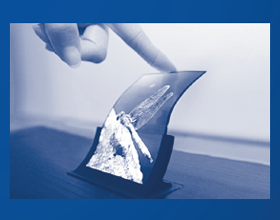
04 Display
Since OLEDs consist of thin organic layers of only a few hundred nanometers, they can be used in not only rigid, but also flexible displays.