

In the first quarter of 2013, the Merck Serono division maintained the strong momentum of the previous quarters. Total revenues increased by 3.5% to € 1,548 million (Q1 2012: € 1,495 million). This reflected robust organic growth of 4.9% and a decline of 1.4% due to changes in foreign exchange rates. The division’s sales rose by 2.6% to € 1,454 million (Q1 2012: € 1,417 million) resulting from organic growth of 4.0% and a negative exchange rate impact of –1.4%. In addition to the division’s two top-selling products, Rebif® for the treatment of multiple sclerosis (MS) as well as the cancer therapy Erbitux®, the diabetes treatment Glucophage® was one of the main drivers of organic growth. Royalty, license and commission income rose 19.4% to € 93 million. (Q1 2012: € 78 million). Apart from positive foreign exchange effects, the main contributors to this strong growth were higher sales of Humira®, a tumor necrosis factor (TNF) blocker which is marketed by the licensee AbbVie Inc., as well as Enbrel®, which was developed by Amgen and is used to treat rheumatological diseases and psoriasis. Furthermore, reduced sales expectations for products that generate royalty and license income for Merck Serono had established a comparatively low basis in the year-earlier quarter.
| XLS |
|
Merck Serono | Key figures – Q1 |
|
|
|
|
|
|
|
|
|
|
|
|
|
|
€ million |
Q1 – 2013 |
Q1 – 2012 |
Change |
|
Total revenues |
1,547.6 |
1,495.3 |
3.5% |
|
Sales |
1,454.3 |
1,417.2 |
2.6% |
|
Operating result (EBIT) |
195.2 |
161.5 |
20.9% |
|
Margin (% of sales) |
13.4% |
11.4% |
|
|
EBITDA |
433.3 |
393.3 |
10.2% |
|
Margin (% of sales) |
29.8% |
27.8% |
|
|
EBITDA pre one-time items |
462.7 |
403.0 |
14.8% |
|
Margin (% of sales) |
31.8% |
28.4% |
|
Merck Serono’s production costs declined by 8.4% to € 249 million in the first quarter of 2013 (Q1 2012: € 272 million). Higher yields in biopharmaceutical production as well as changes in product mix contributed positively to this development. Together with the increase in royalty, license and commission income, this led to a 6.1% increase in gross profit to € 1,299 million (Q1 2012: € 1,224 million) and an improvement in gross margin (in % of sales) to 89.3% (Q1 2012: 86.3%).
Marketing and selling expenses fell by 6.0% to € 312 million (Q1 2012: € 332 million). This reflected not only the cost-lowering measures from the efficiency program, but also the postponement of selling initiatives. These initiatives will be implemented in the coming quarters, potentially leading to higher costs then. Royalty, license and commission expenses rose 14.3% to € 132 million (Q1 2012: € 115 million) mainly due to higher sales of Rebif® in the United States, which triggered higher payments to Pfizer, the distribution partner there.
In the first quarter of 2013, other operating expenses increased by 35.0% to € 128 million (Q1 2012: € 95 million). This was primarily driven by charges related to the efficiency program.
Merck Serono’s R&D spending rose 7.0% to € 324 million. (Q1 2012: € 303 million) owing to higher costs of projects in Phase II and III clinical development, especially in the field of Oncology. In addition, investments into local clinical studies as well as one-time charges weighed on R&D costs.
Amortization of intangible assets decreased by 5.8% to € 155 million (Q1 2012: € 165 million) due to the expiry of the useful life of an intangible asset that was capitalized within the scope of the Serono purchase price allocation. For the same reason, the quarterly level of amortization of intangible assets will decline further in the second half of the year.
Owing to the improvement in gross profit, the division’s EBIT increased by 20.9% to € 195 million (Q1 2012: € 161 million) despite the rise in SG&A costs as well as in research and development expenses. EBIT is now equivalent to 13.4% of sales (Q1 2012: 11.4%). The same applies to EBITDA, which rose by 10.2% to € 433 million (Q1 2012: € 393 million). Excluding the aforementioned one-time items, EBITDA pre grew by 14.8% to € 463 million (Q1 2012: € 403 million) and the EBITDA margin pre one-time items rose to 31.8% (Q1 2012: 28.4%). The percentage increase in EBITDA pre, which was far higher than the percentage increase in gross profit, reflects the improved cost structure of the division as an outcome of the efficiency program.
Sales development by region
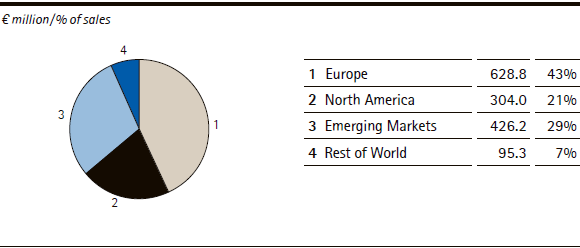
All four regions contributed to the organic sales growth of Merck Serono. However, clear differences in the growth rates could be seen. Europe accounted for the highest proportion, or 43% of the division’s sales (Q1 2012: 44%). However, organic growth was the lowest with 0.7%, resulting in sales of € 629 million (Q1 2012: € 625 million). In addition to a pricing environment that remains difficult, the strained budget situations in several European countries and the resulting health care cost-containment measures left their mark on the business. In contrast to this, sales in Emerging Markets, the division’s second-largest region by sales, grew organically by 8.3% to € 426 million (Q1 2012: € 408 million). This increase was fueled primarily by good sales of Glucophage® and Erbitux®. Overall, Emerging Markets generated an unchanged 29% of divisional sales. Sales in North America benefited from the Rebif® price hikes, which were almost exclusively responsible for organic growth of 5.1% to € 304 million in this region (Q1 2012: € 288 million). Consequently, North America’s contribution to divisional sales rose slightly to 21% (Q1 2012: 20%). Lastly, the Rest of World region reported organic sales growth of 4.5%, mainly thanks to the good sales performance of Erbitux® and the diabetes franchise. The Rest of World region accounted for an unchanged 7% of the division’s sales.
Merck Serono | Sales by region – Q1 2013
| XLS |
|
Merck Serono | Growth components by region – Q1 2013 | |||||
|
|
|
|
|
|
|
|
|
|
|
|
|
|
|
€ million/change in % |
Sales |
Organic growth |
Exchange rate effects |
Acquisitions/ |
Reported |
|
Europe |
628.8 |
0.7% |
– |
– |
0.7% |
|
North America |
304.0 |
5.1% |
0.4% |
– |
5.5% |
|
Emerging Markets |
426.2 |
8.3% |
–3.8% |
– |
4.6% |
|
Rest of World |
95.3 |
4.5% |
–6.2% |
– |
–1.7% |
Sales development by key products and therapeutic areas
At product level, Merck Serono’s top-selling drug Rebif® recorded organic sales growth of 6.0% to € 454 million (Q1 2012: € 430 million). Beside an organic growth of 10.1% in North America as a result of price increases, also Europe contributed to this development, growing, 5.0% organically to € 184 million (Q1 2012: € 176 million). As a result of the good performance in North America, this region generated nearly half of global sales of Rebif® in the first quarter of 2013. Expanding the range of injection devices in the United States, Rebidose® was launched in March after having been granted approval from the U.S. Food and Drug Administration (FDA) in December 2012. Including prefilled syringes and the injection device Rebiject II, patients with relapsing forms of MS now have a total of three Rebif® delivery options to meet their treatment needs. Business performance was mixed in the two other regions. While organic sales in Emerging Markets were lower, declining by 11.9% to € 36 million (Q1 2012: € 44 million), the Rest of World region reported a strong organic increase in sales of 24.8%, totaling € 8 million (Q1 2012: € 7 million). However, at around 10%, the combined contribution of these two regions to Rebif® sales remained comparatively low in the first quarter of 2013.
Thanks to organic growth of 6.6%, sales of Erbitux® rose to € 222 million (Q1 2012: € 214 million). All three regions in which Merck Serono holds the marketing rights to the product contributed to this increase. Europe, which generated € 133 million (Q1 2012: € 130 million) or 60% of sales, posted organic growth of 2.3% as a result of higher sales volumes. Emerging Markets showed the strongest growth, with sales in this region rising organically by 18.0% to € 59 million (Q1 2012: € 52 million), equivalent to 26% of Erbitux® sales in the first quarter of 2013. Lastly, the Rest of World region achieved organic sales growth of 5.4% and sales of € 30 million (Q1 2012: € 32 million). In particular, Japan generated a healthy performance, reversing the declining sales trend of the preceding two quarters and delivering organic growth in the mid single-digit range.
| XLS |
|
Merck Serono | Major products by region, organic growth rates – Q1 2013 | |||||||
|
|
|
|
|
|
|
|
|
|
|
|
|
|
|
|
|
|
|
|
|
Sales |
Europe |
North |
Emerging Markets |
Rest of World |
Change |
|
Rebif® |
€ million |
453.9 |
184.4 |
225.0 |
36.1 |
8.4 |
5.6% |
|
|
organic growth in % |
6.0% |
5.0% |
10.1% |
–11.9% |
24.8% |
|
|
|
% of sales |
100% |
41% |
49% |
8% |
2% |
|
|
Erbitux® |
€ million |
221.7 |
132.7 |
– |
58.5 |
30.4 |
3.8% |
|
|
organic growth in % |
6.6% |
2.3% |
– |
18.0% |
5.4% |
|
|
|
% of sales |
100% |
60% |
– |
26% |
14% |
|
Merck Serono | Organic sales growth by key product – Q1 2013
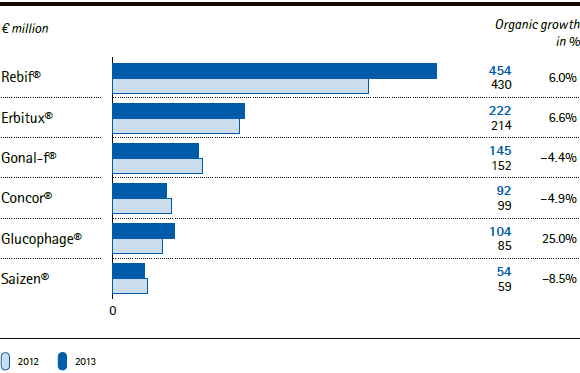
Sales of Gonal-f®, the leading recombinant hormone used in the treatment of infertility, totaled € 145 million in the first quarter of 2013 (Q1 2012: € 152 million). This reflected an organic sales decline of 4.4%, which was primarily attributable to softer business performance in North America.
At € 92 million, first-quarter sales by the Endocrinology business, which mainly consists of products to treat growth disorders, were unchanged versus the year-ago quarter. While organic sales of the growth hormone Saizen® fell by 8.5%, sales of Serostim® for HIV-associated wasting increased as did sales of Kuvan® for the treatment of the metabolic disorder hyperphenylalaninemia. Both Serostim® and Kuvan® recorded double-digit organic growth rates.
In its CardioMetabolicCare & General Medicine business, where Merck Serono also sells products for the treatment of cardiovascular diseaseses, an organic sales growth of 4.1% totaling € 489 million (Q1 2012: € 481 million) was achieved. However, the performance of the three top-selling franchises, namely Glucophage® for the treatment of diabetes, the beta-blocker Concor® and Merck’s portfolio of drugs for the treatment of thyroid disorders varied. While sales of Glucophage® surged organically by 25.0% to € 104 million (Q1 2012: € 85 million) and organic sales of thyroid medicines climbed by 14.8% to € 59 million (Q1 2012: € 51 million) mainly owing to stronger demand in Emerging Markets, sales of Concor® fell organically by 4.9% to € 92 million (Q1 2012: € 99 million) as a result of increasing generic competition, particularly in France.
Merck Serono Pipeline News in Q1 2013
In the field of Oncology Merck announced in late January the initiation of the global Phase III MAESTRO study, assessing the efficacy and safety of investigational hypoxia-targeted drug, TH-302 in combination with gemcitabine, in patients with previously untreated, locally advanced unresectable or metastatic pancreatic adenocarcinoma. MAESTRO is a randomized, placebo-controlled, international, multi-center, double-blind Phase III trial of TH-302 plus gemcitabine compared with placebo plus gemcitabine and is expected to enroll 660 patients. The primary efficacy endpoint is overall survival; the secondary endpoints include efficacy measured by progression-free survival (PFS), overall response rate and disease control rate, as well as assessments of safety and tolerability, pharmacokinetics and biomarkers. The study is being conducted under a Special Protocol Assessment (SPA) with FDA. An SPA is a review conducted by FDA on a clinical trial that will form the primary basis of an efficacy claim in a marketing application.
In late February, Merck announced that its Phase III CENTRIC study of the investigational integrin inhibitor cilengitide did not reach its primary endpoint, of significantly increasing overall survival when added to the current standard chemoradiotherapy (temozolomide and radiotherapy). The CENTRIC study included patients with newly diagnosed glioblastoma and methylated O(6)-methylguanine-DNA methyltransferase (MGMT) gene promoter status. The trial was planned and is being conducted in partnership with the European Organisation for Research and Treatment of Cancer (EORTC). Detailed results from the trial were submitted for presentation at the American Society of Clinical Oncology (ASCO) 2013. In view of the outcome of this study it was decided to discontinue the overall development program for cilengitide, including the Phase II CERTO study in non-small cell lung cancer (NSCLC).
In the field of Immunology on March 18, Merck announced a strategic alliance with Nordic Bioscience Clinical Development A/S on Merck’s investigational drug sprifermin (recombinant human FGF-18) in osteoarthritis (OA) of the knee. Sprifermin is a protein thought to induce chondrocyte stimulation leading to matrix synthesis and chondrocyte renewal, and is delivered by intra-articular injection. Under the terms of the agreement, Nordic Bioscience will provide clinical development services to Merck on a shared-risk basis in exchange for a payment structure that includes service fees and potential milestone and royalty payments on the program. Merck retains full responsibility for the development and commercialization of the investigational drug. The alliance will draw on the joint expertise and resources of Merck and Nordic Bioscience to conduct a multi-national Phase IIb trial (the FORWARD study) to further evaluate sprifermin for inhibition of the progression of structural damage, reduction of pain and improvement of physical function in patients with OA of the knee. The FORWARD study is expected to begin enrollment in the second half of 2013.
In January, Merck and the Feinstein Institute for Medical Research, the research division of the North Shore-Long Island Jewish Health System in New York, announced that they will collaborate to develop antibodies for the treatment of systemic lupus erythematosus (SLE). Under the terms of the agreement, Merck Serono will fund a research program at the Feinstein Institute and be responsible for the development and commercialization of the antibodies resulting from the collaboration. The program will focus on the use of antibodies to inhibit the action of certain proteins responsible for inflammation in the pathogenesis of SLE, a disease with high unmet medical needs. Merck Serono is currently investigating atacicept for the treatment of SLE. The complete Phase II clinical and biomarker data are expected to be presented at a scientific conference in the first half of 2013. The collaboration with the Feinstein Institute will allow Merck Serono to further strengthen its research into alternative mechanisms for the treatment of SLE.
In early March, Merck Serono announced the creation of Calypso Biotech, a further spin-off company resulting from its Entrepreneur Partnership Program in Geneva. Formed around an R&D portfolio in the field of inflammatory bowel diseases, Calypso will target selected niche indications with high unmet medical needs.
In early February, Merck announced that it had been granted an option by Opexa Therapeutics, Inc. for the development and commercialization of Tcelna™ (imilecleucel-T), a potential first-in-class personalized T-cell therapy for patients suffering from MS. Tcelna™ is being developed by Opexa and currently is in a Phase IIb clinical trial in patients with Secondary Progressive MS (SPMS). It is being developed as a personalized therapy specifically tailored to each patient’s individual disease profile and has been evaluated in Phase I and II clinical studies in MS that included SPMS patients. Tcelna™has received Fast Track Designation from the United States FDA as a potential treatment for SPMS.
Merck Serono will decide on the future of the L-BLP25 development program (MUC1 antigen-specific cancer immunotherapy) and on ONO-4641, the division’s sphingosine-1-phosphate receptor modulator for the treatment of MS, during the course of 2013. The division plans to move ahead with the development of a portfolio of biosimilar compounds in oncology based on a co-development agreement signed with Dr. Reddy’s Laboratories in 2012.
 search hit 03
