

 3
3
| XLS |
|
Merck Serono | Key figures |
||||||||
|
|
|
|
|
|
|
|
||
|
|
|
|
|
|
|
|
||
|
€ million |
Q2 – 2014 |
Q2 – 20131 |
Change in % |
Jan.–June 2014 |
Jan.–June 20131 |
Change in % |
||
|
||||||||
|
Total revenues |
1,510.7 |
1,560.5 |
–3.2 |
2,931.8 |
3,042.6 |
–3.6 |
||
|
Sales |
1,446.4 |
1,467.6 |
–1.4 |
2,821.3 |
2,856.3 |
–1.2 |
||
|
Operating result (EBIT) |
239.7 |
266.4 |
–10.0 |
475.5 |
436.6 |
8.9 |
||
|
Margin (% of sales) |
16.6 |
18.2 |
|
16.9 |
15.3 |
|
||
|
EBITDA |
444.3 |
477.7 |
–7.0 |
872.3 |
886.0 |
–1.6 |
||
|
Margin (% of sales) |
30.7 |
32.6 |
|
30.9 |
31.0 |
|
||
|
EBITDA pre one-time items |
452.0 |
474.8 |
–4.8 |
890.1 |
912.5 |
–2.5 |
||
|
Margin (% of sales) |
31.3 |
32.4 |
|
31.5 |
31.9 |
|
||
|
Business free cash flow |
337.3 |
485.7 |
–30.6 |
817.3 |
825.7 |
–1.0 |
||
Development of sales and results of operations
In the second quarter of 2014, the Merck Serono division generated moderate organic sales growth of 3.0%. However, owing to negative exchange rate effects of –4.4%, divisional sales declined slightly by a total of –1.4% to € 1,446 million (Q2 2013: € 1,468 million). Nearly all the franchises contributed to the organic sales growth of the division. Only sales the multiple sclerosis treatment Rebif® fell short of the year-earlier number. The portfolio for the treatment of thyroid disorders, as well as Gonal-f®, the leading recombinant hormone used in the treatment of infertility, performed particularly well in the second quarter of 2014.
Merck Serono | Sales by region – Q2 2014
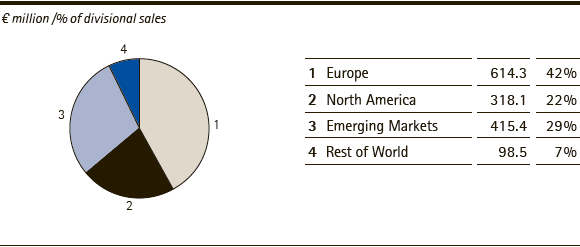
Europe, the division’s top-selling region, posted a slight organic sales decline of –0.4% and a negative foreign exchange impact of –0.4%, thereby generating sales of € 614 million (Q2 2013: € 619 million). At 42%, Europe accounted for the largest proportion of the division’s sales, as in the previous year.
Emerging Markets, the division’s second-largest region by sales, delivered strong organic growth of 16.7% but sustained a considerable negative foreign exchange impact of –10.3%. Consequently, sales increased to € 415 million from € 391 million. This region’s share of divisional sales rose from 27% in the year-earlier quarter to 29% in the second quarter of 2014. China and Brazil were the main contributors to organic growth.
In the second quarter of 2014, sales in North America totaled € 318 million, decreasing by –10.2% in comparison with the year-earlier quarter (€ 354 million). This reflects an organic sales decline of –5.7% and unfavorable exchange rate effects of –4.6%. The organic change was mainly due to lower sales of Rebif® in the United States. North America’s contribution to divisional sales fell by two percentage points to 22% (Q2 2013: 24%).
Sales in the Rest of World region grew organically by 1.1% in the second quarter of 2014. However, currency headwinds of –5.9% caused sales to decrease to € 99 million (Q2 2013: € 103 million). Sales in the region developed particularly positively with the oncology drug Erbitux®. Once again, the Rest of World region contributed 7% to divisional sales.
| XLS |
|
Merck Serono | Sales components by region – Q2 2014 |
|||||
|
|
|
|
|
|
|
|
|
|
|
|
|
|
|
€ million |
Sales |
Organic growth |
Exchange rate effects |
Acquisitions/ divestments |
Total change |
|
Europe |
614.3 |
–0.4 |
–0.4 |
– |
–0.8 |
|
North America |
318.1 |
–5.7 |
–4.6 |
– |
–10.2 |
|
Emerging Markets |
415.4 |
16.7 |
–10.3 |
– |
6.4 |
|
Rest of World |
98.5 |
1.1 |
–5.9 |
– |
–4.8 |
|
Merck Serono |
1,446.4 |
3.0 |
–4.4 |
– |
–1.4 |
In the second quarter of 2014, sales of the two top-selling products of the Merck Serono division developed as follows:
Sales of Rebif®, which is used to treat relapsing forms of multiple sclerosis, declined organically by –2.8% in the second quarter of 2014 against the backdrop of an increasingly difficult competitive situation. Taking adverse exchange rate effects of –4.2% into account, Rebif® sales decreased by a total of –7.0% to € 464 million (Q2 2013: € 499 million). This development was mainly due to the North America region, which is the largest market for Rebif®, accounting for 52% (Q2 2013: 54%) of this product’s overall sales. The price increases implemented last year could not compensate for lower sales volumes. Consequently, sales declined organically by –7.1%. Including negative exchange rate effects of –4.4%, which stemmed mainly from the U.S. dollar, Merck Serono generated Rebif® sales of € 240 million in North America (Q2 2013: € 271 million). In Europe, which accounts for 38% of sales (Q2 2013: 37%) and is the second-largest region for the product, sales of Rebif® declined to € 175 million (Q2 2013: € 186 million) due to a –5.4% organic decrease in sales and negative exchange rate effects of –0.5%. The organic sales decline was attributable to the market environment, which is becoming increasingly difficult in Europe as well. The Emerging Markets and Rest of World regions, which together accounted for a 10% share of sales (Q2 2013: 9%), posted sales growth.
In the second quarter of 2014, sales of the oncology drug Erbitux® showed strong organic growth of 11.3%. Taking negative currency effects of –4.9% into account, sales rose by a total of 6.5% to € 229 million (Q2 2013: € 215 million). Sales developed positively in all three regions in which Merck Serono holds the marketing rights. In Europe, where 57% of Erbitux® sales were generated (Q2 2013: 58%), making it the top-selling region for this product, Erbitux® sales grew organically by 3.2%. Coupled with slightly positive exchange rate effects of 0.2%, sales thus amounted to € 130 million (Q2 2013: € 125 million). At 28.2%, the Emerging Markets region generated the strongest organic growth for this oncology drug, delivering sales of € 63 million (Q2 2013: € 55 million). This region’s contribution to total Erbitux® sales thus increased to 27% (Q2 2013: 26%). The largest contributions were made by China and the majority of Latin American countries. In the Latin America, one-time deliveries contributed to sales in the second quarter of 2014. In the Rest of World region, Merck Serono generated organic sales growth of 14.1%. Including negative foreign exchange effects, this led to Erbitux® sales of € 37 million (Q2 2013: € 35 million). In Japan, which was the strongest growth driver in past quarters, sales rose by 5.9%, which was not as strong as in the previous quarters.
| XLS |
|
Merck Serono | Sales and organic growth of Rebif® and Erbitux® by region – Q2 2014 |
||||||
|
|
|
|
|
|
|
|
|
|
|
|
|
|
|
|
|
|
|
Total |
Europe |
North America |
Emerging Markets |
Rest of World |
|
Rebif® |
€ million |
464.3 |
174.8 |
239.6 |
39.8 |
10.2 |
|
|
Organic growth in % |
–2.8 |
–5.4 |
–7.1 |
37.8 |
29.0 |
|
|
% of sales |
100 |
38 |
52 |
8 |
2 |
|
Erbitux® |
€ million |
228.9 |
129.5 |
– |
62.9 |
36.5 |
|
|
Organic growth in % |
11.3 |
3.2 |
– |
28.2 |
14.1 |
|
|
% of sales |
100 |
57 |
– |
27 |
16 |
Sales and the organic growth rates of the other key products developed as follows:
Merck Serono | Sales and organic growth of key products – Q2 2014
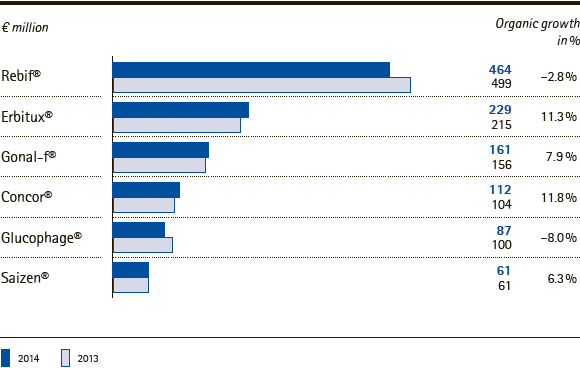
In the second quarter of 2014, Merck Serono generated organic sales growth of 7.9% with Gonal-f®. Including adverse foreign exchange effects, sales increased by 3.3% to € 161 million (Q2 2013: € 156 million). Sales of Gonal-f® showed the strongest growth in the Emerging Markets region, with particularly high growth rates achieved in China.
Sales by the Endocrinology franchise, which mainly consists of products to treat metabolic and growth disorders, rose organically by 3.9%. Including negative exchange rate effects of –5.0%, sales totaled € 100 million (Q2 2013: € 101 million). Sales of the growth hormone Saizen®, the top-selling product of this franchise, saw an organic increase of 6.3% as well as negative exchange rate effects of –6.1%. Consequently, sales remained at the previous year’s level of € 61 million.
The General Medicine franchise (including CardioMetabolic Care), which commercializes Merck Serono’s products to treat cardiovascular diseases and diabetes, among others, generated organic sales growth of 2.4%. Organic sales of products to treat thyroid disorders developed particularly well in the second quarter of 2014. The decline in sales of Glucophage®, which is used to treat diabetes, to € 87 million (Q2 2013: € 100 million), was largely due to ongoing supply chain issues in Europe. Including negative exchange rate changes of –4.5%, sales by the General Medicine franchise amounted to € 410 million (Q2 2013: € 419 million).
During the first half of 2014, the division’s sales decreased slightly by –1.2% to € 2,821 million (January-June 2013: € 2,856 million). Reported sales are based on organic growth of 3.6% as well as negative exchange rate effects of –4.8%, which mainly stemmed from the U.S. dollar, Latin American currencies and the Japanese yen. The division’s sales of Rebif® totaled € 924 million (January-June 2013: € 953 million). Despite organic growth of 1.0%, Rebif® sales declined by a total of –3.1% due to negative foreign exchange effects. Sales of Erbitux®, Merck Serono’s second best-selling product, increased slightly by 0.3% to € 438 million (January-June 2013: € 437 million). Organic growth of 5.8% was largely offset by negative foreign exchange effects. In Europe, the top-selling region for Erbitux®, sales of the product slipped organically by –2.2%, leading to first-half sales of € 252 million (January-June 2013: € 258 million). In the Emerging Markets and Rest of World regions, Erbitux® generated very good organic growth rates, which however were burdened by negative exchange rate effects. Sales in the Emerging Markets region rose by a total of 3.2% to € 117 million (January-June 2013: € 114 million). In the Rest of World region, sales increased by 5.2% to € 68 million (January-June 2013: € 65 million).
The Fertility franchise, where Gonal-f® is the top-selling product, delivered sales of € 314 million (January-June 2013: € 301 million), which reflected organic growth of 9.4% and an adverse foreign exchange impact of –5.2%. During the first half of 2014, the Endocrinology franchise generated sales of € 188 million (January-June 2013: € 193 million). Divisional sales of products from the General Medicine franchise (including CardioMetabolic Care) amounted to € 791 million (January-June 2013: € 816 million).
The division’s results of operations developed as follows:
| XLS |
|
Merck Serono | Results of operations |
||||||||
|
|
|
|
|
|
|
|
||
|
|
|
|
|
|
|
|
||
|
€ million |
Q2 – 2014 |
Q2 – 20131 |
Change in % |
Jan.–June 2014 |
Jan.–June 20131 |
Change in % |
||
|
||||||||
|
Sales |
1,446.4 |
1,467.6 |
–1.4 |
2,821.3 |
2,856.3 |
–1.2 |
||
|
Royalty, license and commission income |
64.3 |
92.9 |
–30.8 |
110.5 |
186.2 |
–40.7 |
||
|
Total revenues |
1,510.7 |
1,560.5 |
–3.2 |
2,931.8 |
3,042.6 |
–3.6 |
||
|
|
|
|
|
|
|
|
||
|
Cost of sales |
–249.2 |
–258.2 |
–3.5 |
–503.6 |
–488.4 |
3.1 |
||
|
Gross profit |
1,261.4 |
1,302.3 |
–3.1 |
2,428.2 |
2,554.2 |
–4.9 |
||
|
|
|
|
|
|
|
|
||
|
Marketing and selling expenses |
–323.9 |
–332.1 |
–2.5 |
–603.6 |
–626.9 |
–3.7 |
||
|
Royalty, license and commission expenses |
–133.8 |
–151.6 |
–11.7 |
–265.6 |
–283.1 |
–6.2 |
||
|
Administration expenses |
–56.0 |
–49.7 |
12.7 |
–108.2 |
–99.9 |
8.3 |
||
|
Other operating expenses and income |
–53.5 |
–53.1 |
0.7 |
–79.8 |
–180.8 |
–55.9 |
||
|
Research and development costs |
–311.6 |
–294.5 |
5.8 |
–609.9 |
–617.0 |
–1.1 |
||
|
Amortization of intangible assets |
–142.9 |
–154.8 |
–7.7 |
–285.5 |
–309.9 |
–7.8 |
||
|
Operating result (EBIT) |
239.7 |
266.4 |
–10.0 |
475.5 |
436.6 |
8.9 |
||
|
Depreciation / Amortization / Reversals of impairments |
204.6 |
211.3 |
–3.2 |
396.7 |
449.4 |
–11.7 |
||
|
(of which: one-time items) |
(2.6) |
(3.8) |
(–32.7) |
(3.8) |
(30.5) |
(–87.4) |
||
|
EBITDA |
444.3 |
477.7 |
–7.0 |
872.3 |
886.0 |
–1.6 |
||
|
Restructuring costs |
7.2 |
–4.0 |
– |
16.7 |
24.6 |
–32.1 |
||
|
Integration costs / IT costs |
0.6 |
1.2 |
–51.0 |
1.1 |
1.9 |
–41.9 |
||
|
Gains / losses on the divestment of businesses |
– |
– |
– |
– |
– |
– |
||
|
Acquisition costs |
– |
– |
– |
– |
– |
– |
||
|
Other one-time items |
– |
– |
– |
– |
– |
– |
||
|
EBITDA pre one-time items |
452.0 |
474.8 |
–4.8 |
890.1 |
912.5 |
–2.5 |
||
Royalty, license and commission income, which besides sales is also reported as part of total revenues, dropped substantially by –30.8% to € 64 million in the second quarter of 2014 (2013: € 93 million). This was due primarily to lower royalty and license income from Avonex® and Enbrel®. The agreement reached with Bristol-Myers Squibb in 2013 on the co-promotion of Glucophage® in China had a positive effect on commission income in comparison with the year-earlier quarter.
Taking into account the development of sales and total revenues as well as cost of sales, the gross profit of the Merck Serono division fell by € –41 million to € 1,261 million, leading to a gross margin of 87.2% (Q2 2013: 88.7%). Lower royalty, license and commission income as well as the negative impact of exchange rates on sales were primarily responsible for this decrease. Royalty, license and commission expenses declined by –11.7% to € 134 million, which was mainly due to lower Rebif® co-promotion expenses in the United States. In the second quarter of 2014, other operating expenses included impairments of intangible assets amounting to € 14 million in connection with the return of the license rights to ceralifimod (see also “License rights to ceralifimod returned” in the Notes to the Consolidated Financial Statements). The increase in research and development costs relates mainly to quarterly fluctuations in R&D spending, as well as one-time effects. Lower amortization of intangible assets was the outcome of the expiration of the amortization periods for the intangible asset Avonex®, which was part of the Serono acquisition. After eliminating depreciation and amortization, and adjusted for one-time items, EBITDA pre one-time items declined by –4.8% to € 452 million and the EBITDA margin pre one-time items was 31.3% (Q2 2013: 32.4%).
In the first half of 2014, Merck Serono recorded EBITDA pre one-time items of € 890 million. The slight decrease of –2.5% in this key performance indicator reflects, among other things, the negative impact of exchange rate developments on earnings as well as the decline in royalty and license income. The EBITDA margin pre one-time items fell slightly to 31.5% (January-June 2013: 31.9%).
Development of business free cash flow
In the second quarter of 2014, business free cash flow of the Merck Serono division fell significantly by € 148 million to € 337 million (Q2 2013: € 486 million). All business free cash flow components contributed to this development. The changes in trade accounts receivable had the strongest impact. Whereas in the year-earlier quarter, cash generated by the reduction in receivables amounted to € 32 million, in the second quarter of 2014, cash used owing to the increase in receivables was € –71 million.
| XLS |
|
Merck Serono | Business free cash flow |
||||||||
|
|
|
|
|
|
|
|
||
|
|
|
|
|
|
|
|
||
|
€ million |
Q2 – 2014 |
Q2 – 20131 |
Change in % |
Jan.–June 2014 |
Jan.–June 20131 |
Change in % |
||
|
||||||||
|
EBITDA pre one-time items |
452.0 |
474.8 |
–4.8 |
890.1 |
912.5 |
–2.5 |
||
|
Investments in property, plant and equipment, software as well as advance payments for intangible assets |
–41.6 |
–32.2 |
28.9 |
–67.7 |
–50.8 |
33.3 |
||
|
Changes in inventories |
–2.5 |
11.3 |
–122.1 |
–9.4 |
–4.6 |
106.9 |
||
|
Changes in trade accounts receivable |
–70.7 |
31.9 |
– |
4.3 |
–31.5 |
–113.7 |
||
|
Business free cash flow |
337.3 |
485.7 |
–30.6 |
817.3 |
825.7 |
–1.0 |
||
Owing to the high level of business free cash flow in the first quarter of 2014, Merck Serono’s business free cash flow in the first half of 2014 almost matched the high year-earlier level. In comparison with the first half of 2013, business free cash flow declined by just € 8 million or 1.0% to € 817 million.
