

The Consumer Health Care division generated total revenues of EUR 108 million, only slightly more than the year-ago quarter. Sales were mainly impacted by Venezuela, one of the division’s largest markets in Latin America. Beside Merck’s decision to calculate transactions at the free-market exchange rate, the subsidiary in Venezuela posted very low sales during January to avoid the risk of government backlash post devaluation. In addition, most European markets declined due to the severe winter.
|
Consumer Health Care | Key figures – Q1 |
|||
|
|
|
|
|
|
EUR million |
1st quarter |
1st quarter |
Change |
|
Total revenues |
107.6 |
107.5 |
– |
|
Gross margin |
72.8 |
73.5 |
–0.9 |
|
Research and development |
–4.8 |
–4.3 |
11.7 |
|
Operating result |
1.5 |
7.9 |
–80.9 |
|
Exceptional items |
– |
– |
– |
|
Free cash flow |
–2.5 |
3.2 |
– |
|
Underlying free cash flow |
–2.5 |
3.2 |
– |
|
ROS in % |
1.4 |
7.3 |
|
Global sales of Femibion®, the vitamins and minerals supplement for pregnant women and nursing mothers, were up 22% compared to the year-ago quarter due to increased demand in Europe.
Sales of Bion®3, the multivitamins with probiotics, rose 14% due to new television and point-of-sale advertising campaigns in France. Sales of Diabion®, multivitamins for people with diabetes, increased 16%, boosted by demand in Mexico and China. The vitamin C products marketed under the Cebion® brand recorded a 28% drop in sales, mostly due to the issues in Venezuela as mentioned above.
Sales of Nasivin® nasal spray declined 4.6% in the first quarter and are still influenced by the weakness of the Russian market.
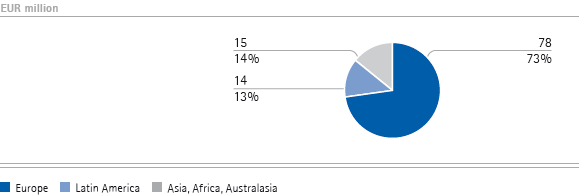
Consumer Health Care | Sales by Region – Q1
First-quarter sales of Kytta®, which is also branded as Flexagil®, was on a par with the year-ago quarter.
The division’s gross margin declined slightly to EUR 73 million in the first quarter from EUR 74 million in the year-ago quarter. This was partially due to the fact that the division had to cover risks associated with the currency valuation in Venezuela. Marketing and selling costs rose as the division continued to implement its strategy of driving growth via strategic brands. These brands, excluding mail-order business, grew 3% and now account for 55% of the division’s sales.
Research and development costs rose 12% to EUR 4.8 million.
Due to a lower gross margin and higher costs, the operating result declined 81% to EUR 1.5 million compared to the year-ago quarter. ROS dropped to 1.4% compared to 7.3% in the first quarter of 2009. Free cash flow was EUR –2.5 million compared to EUR 3.2 million in the year-ago quarter.
 back
back
