
Corporation with general partners (Kommanditgesellschaft auf Aktien)
The corporation with general partners is a company that constitutes a separate legal entity in which at least one partner has unlimited liability with regard to the creditors of the company (general partner) and in which the other shareholders are not personally liable for the obligations of the company (limited shareholders) (section 278 (1) of the German Stock Corporation Act – hereinafter referred to as “AktG”). It is therefore a hybrid of an Aktiengesellschaft (German stock corporation) and a Kommanditgesellschaft (limited partnership) with a focus on German stock corporation law. Distinctive differences to the Aktiengesellschaft include the presence of general partners, who essentially also manage the company’s business activities, the absence of a management board, and the restriction of rights and obligations of the supervisory board (see: supervisory board procedures). This legal form also involves special features with regard to the General Meeting. For example, many of the resolutions made require the consent of the general partners (section 285 (2) AktG), including the adoption of the annual financial statements (section 286 (1) AktG). A large number of the conduct recommendations contained in the Code, which is geared toward Aktiengesellschaften, can therefore only be applied to a KGaA as appropriate.
Merck KGaA
The general partner E. Merck KG holds around 70% of the total capital of Merck KGaA (equity interest); the shareholders hold the remainder, which is divided into shares (share capital). E. Merck KG is excluded from the management of business activities. The general partners with no equity interest (Executive Board), on the other hand, manage business activities. Nevertheless, due to its substantial capital investment and unlimited personal liability, E. Merck KG has a strong interest in the businesses of Merck KGaA operating efficiently and in compliance with procedures, and exercises its influence accordingly. Merck KGaA’s participation in the profit/loss of E. Merck KG in accordance with Articles 26 et seq. of the Articles of Association further harmonizes the interests of the shareholders and of E. Merck KG.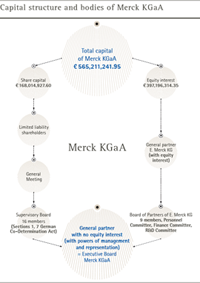
E. Merck KG appoints and dismisses the Executive Board. In addition, E. Merck KG has created bodies – complementing the expertise and activities of the Supervisory Board – to monitor and advise the Executive Board. This task applies primarily to the Board of Partners of E. Merck KG. Based on the provisions of the German Stock Corporation Act, the Articles of Association of Merck KGaA and the rules of procedure of the various committees, Merck KGaA has a set of rules for the Executive Board and its supervision that meet the requirements of the Code. The investors, who bear the entrepreneurial risk, are protected as provided for by the Code.
The General Meeting of Merck KGaA
The Annual General Meeting takes place within the first eight months of the fiscal year. The sixteenth General Meeting of Merck KGaA was held in Frankfurt am Main, Germany, on April 18, 2011. At 56.60%, the proportion of share capital represented at the meeting was stable. At 58.22%, the proportion was slightly higher in 2010.
In accordance with Article 21 (3) of the company’s Articles of Association, the annual financial statements, the management report, the report of the Supervisory Board, and the proposal on the appropriation of net retained profit must be presented to the General Meeting and explained during the General Meeting. In particular, the Annual General Meeting passes resolutions concerning the approval of the annual financial statements, the appropriation of net retained profit, the approval of the actions of the Executive Board members and the Supervisory Board members, as well as the choice of the auditor. At the same time, the General Meeting has the power to pass resolutions concerning changes to the Articles of Association. With certain exceptions (such as the measures listed in section 285 (2) sentence 2 AktG), the resolutions of the General Meeting require the approval of the general partners.
All the documents and information concerning upcoming General Meetings are posted on our website. Moreover, the General Meeting is webcast live on the Internet from its commencement until the end of the speech by the Chairman of the Executive Board. The introductory speeches by the Chairman of the Executive Board and the Chairman of the Supervisory Board are recorded in order to make them available to interested members of the public at any time after the meeting. In this way, we are satisfying our own high transparency requirements.
Shareholder rights
The shareholders of Merck KGaA exercise their rights at the General Meeting. Each Merck share grants the holder one vote at the General Meeting.
Shareholders may exercise their voting rights personally, through an authorized representative, or through a proxy appointed by the company. Voting rights are only subject to special restrictions in accordance with Article 22 (5) of the company’s Articles of Association. Accordingly, insofar as general partners hold shares, they cannot exercise the voting rights deriving from their shares with respect to the election and dismissal of the Supervisory Board, the approval of the actions of the Executive Board members and the Supervisory Board members, the election of the auditor, the appointment of special auditors and the resolution on indemnification claims.
A summary explanation of shareholder rights with respect to the General Meeting is available in German on the company’s website.
Statement of Compliance
On February 24, 2012, the Executive Board and the Supervisory Board issued, in accordance with section 161 of the German Stock Corporation Act (Aktiengesetz), the following statement of compliance with the recommendations of the German Federal Government Commission on the Corporate Governance Code:
With the exception of the following instance, since the last statement of compliance on February 17, 2011, the Merck Group has complied with the recommendations of the German Federal Government Commission on the Corporate Governance Code published on May 26, 2010, and shall continue to do so in the future.
Contrary to section 5.4.1 sentence 2, an age limit is not taken into account when proposing candidates for election to the Supervisory Board. The age of Supervisory Board members is not a criterion for their qualifications and competence. Moreover, we do not wish to forgo the many years of experience of Supervisory Board members.
 back
back
