

The Performance Materials division comprises Merck’s materials businesses and activities, i.e. Liquid Crystals, Pigments & Cosmetics, as well as Advanced Technologies such as materials for OLEDs (organic light-emitting diodes), LEDs (light-emitting diodes), photovoltaics and other innovative technologies.
|
Performance Materials | Key figures |
|
|
|
|
|
|
|
EUR million |
Q1 – 2011 |
Q1 – 2010 |
|
Total revenues |
408.7 |
354.9 |
|
Gross margin |
264.2 |
225.9 |
|
Research and development |
–36.5 |
–31.3 |
|
Operating result |
168.8 |
131.5 |
|
Exceptional items |
157.0 |
– |
|
Free cash flow |
298.6 |
106.7 |
|
Underlying free cash flow |
97.6 |
106.7 |
|
ROS in % |
41.3 |
37.1 |
Total revenues of the division rose 15% in the first quarter of 2011 to EUR 409 million from EUR 355 million in the year-ago quarter. Positive currency effects accounted for 6.4 percentage points of the revenue increase with 13.7 percentage points stemming from organic growth. The divestment of the Crop BioScience business during the first quarter reduced revenues by 4.9%.
The larger share of the division’s revenues stems from the Liquid Crystals business unit which posted robust growth in the first quarter. This was largely due to the continued high demand for Merck’s broad range of high-quality liquid crystal materials, which are used in flat panel screens for televisions, computer monitors, tablets, and smart phones, among other applications.
Performance Materials | Sales by region – Q1
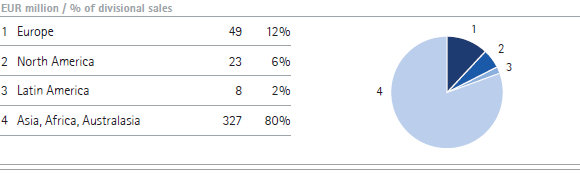
Sales by the Pigments & Cosmetics business unit rose to a record high as demand in both the industries it serves continued to improve.
The March 11 earthquake in Japan, which disrupted power supplies and damaged roads and other infrastructure in the northeastern part of the country, did not affect the division’s Liquid Crystals business and had only minor financial impact on the pigments business in the first quarter due to damage to the production plant in Onahama. Merck expects production at Onahama to resume in early June. In addition, before the end of this year, Merck intends to begin producing its popular Xirallic® pigments for automotive coatings additionally at a site in Europe. Besides Japan, Merck produces effect pigments in Germany, China and the United States.
The Performance Materials division’s production costs grew at a slower rate than total revenues, leading to a gross margin increase of 17% to EUR 264 million in the first quarter compared to EUR 226 million in the year-ago quarter. Production utilization was at a high level for both liquid crystals and pigments.
Research and development costs rose by 17% to EUR 36 million, or 8.9% of total revenues, in the first quarter. This comparatively high R&D spending rate for a chemicals business is justified by the high-margin technological advances Merck scientists produce.
With a gross margin that rose faster than expenses, the operating result of the Performance Materials division increased 28% to EUR 169 million in the first quarter compared to EUR 132 million in the year-ago quarter. The division’s ROS was 41.3% compared to 37.1% the first quarter of 2010.
Free cash flow for the Performance Materials division rose to EUR 299 million in the first quarter from EUR 107 million in the year-ago quarter. The first-quarter underlying free cash flow was EUR 98 million in 2011 and EUR 107 million in 2010.
The division booked an exceptional item of EUR 157 million on the sale of its Crop BioScience business to Novozymes A/S of Denmark.
 back
back
