

Merck Serono discovers, develops, manufactures and markets prescription medicines of both chemical and biological origin. It is the largest division of the Merck Group, accounting for 58% of Group total revenues in the third quarter.
|
Merck Serono | Key figures |
|
|
||
|
|
|
|
|
|
|
€ million |
Q3 – 2011 |
Q3 – 2010 |
Jan.–Sep. |
Jan.–Sep. |
|
Total revenues |
1,468.8 |
1,393.5 |
4,375.9 |
4,250.7 |
|
Gross margin |
1,225.1 |
1,199.8 |
3,633.7 |
3,605.1 |
|
Research and development |
–297.1 |
–279.6 |
–904.0 |
–880.2 |
|
Operating result |
174.3 |
209.5 |
176.1 |
551.1 |
|
Exceptional items |
– |
– |
6.8 |
– |
|
Free cash flow |
381.7 |
410.4 |
1,075.0 |
859.3 |
|
Underlying free cash flow |
381.8 |
410.4 |
804.7 |
859.3 |
|
ROS in % |
11.9 |
15.0 |
4.0 |
13.0 |
Business development
Merck Serono’s total revenues during the third quarter increased 5.4% to € 1,469 million compared to € 1,393 million in the year-ago quarter, representing a solid performance in a difficult environment of lower health care spending by governments and other payers.
Foreigns currency exchange rate movements reduced revenue growth by 1.9% and the divestment of the Théramex women’s health business in 2010 also had the effect of lowering revenue growth by 1.5%. Adjusted for these items, Merck Serono generated organic revenue growth of 8.9% in the quarter.
In the third quarter of 2010, Merck Serono made the decision to change its distribution strategy in the Chinese market. This resulted in lower revenues in the third quarter of 2010 as the change was implemented. Adjusted for this further effect, Merck Serono organic revenue growth was approximately 6% in the third quarter of 2011.
From a geographic perspective, the majority of the division’s organic sales growth came from Asia and emerging markets, with the strong performance in North America attributable to solid Rebif® sales.
Royalty, license and commission income rose by 7.2% to € 94 million in the third quarter, primarily to adjust accruals made in previous quarters.
Merck Serono | Sales by region – Q3
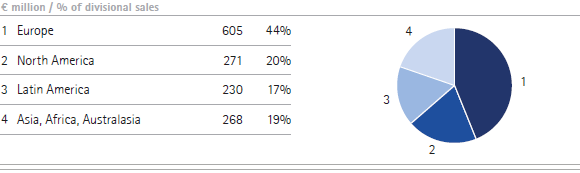
The division’s cost of sales rose 26% in the third quarter. This increase was due to currency effects – mainly the strong Swiss franc – plus a negative product mix as well as start-up costs for the new biotech production plant in Switzerland.
Consequently, the gross margin rose by 2.1% to € 1,225 million. Marketing and selling costs were nearly unchanged at € 344 million. Royalty, license and commission expenses rose 16% to € 128 million, largely on higher third-party sales for Rebif® and Erbitux®.
As already announced in the second quarter, the amortization period of Rebif® is being reduced by two years, reflecting the impact of oral multiple sclerosis drugs entering the market. This decision had the effect of increasing amortization by an incremental € 17 million per quarter through 2019. As a result, amortization of intangible assets increased in the third quarter by 11% to € 164 million from € 148 million in the year-ago quarter.
The division’s third-quarter operating result declined by 17% to € 174 million from € 210 million in the year-ago quarter. The third-quarter underlying core operating result, which excludes amortization of intangible assets and one-time charges, was € 338 million, or 23.0% of revenues, compared to € 358 million, or 25.7% of revenues, in the third quarter of last year.
Joining the Merck Serono executive management team in September were: Dr. Belén Garijo, Chief Operating Officer; Dr. Annalisa Jenkins, Global Head of Drug Development & Medical; and James Stewart, Head of the Strategy Realization Office.
Therapeutic areas
Global sales of Rebif® for the treatment of relapsing forms of multiple sclerosis rose 4.7% to € 426 million in the third quarter or 8.4% on an organic basis. The increase is largely due to a 20% organic increase in the United States, which was primarily attributable to price increases in January and June.
Sales of the targeted cancer treatment Erbitux® increased 4.7% on an organic basis to € 218 million primarily as a result of growth in emerging markets. Sales of Erbitux® are recovering in Japan, where it has been transitioning from third-line to first-line metastatic colorectal cancer and now requires KRAS testing in all lines. Erbitux® sales in Japan declined 23% organically following a 36% organic sales decline in the second quarter of 2011.
Third-quarter sales of Gonal-f®, a recombinant hormone used in the treatment of infertility, rose to € 123 million and generated 9.3% organic sales growth in the quarter. Gonal-f® has been performing well due to the strength of its brand, its exposure in emerging markets, and good lifecycle management.
Merck Serono’s Endocrinology business also performed strongly in the third quarter, posting sales of € 90 million, which represented 17% organic sales growth. This therapeutic area includes six brands, two of which have been launched during the past two years. Sales of the recombinant growth hormone Saizen® for the treatment of growth-hormone deficiency were € 59 million, representing a 9.6% organic sales growth in the quarter. Another growth driver in this franchise is Kuvan®, which was launched in 2009 and already is available in 35 countries. It is the first and only prescription drug for the treatment of the rare diseases hyperphenylanlaninemia (HPA) in adults and phenylketonuria (PKU) in children.
Merck Serono’s primary care products continued to contribute significantly to the division’s overall sales. Sales of the branded Concor® (bisoprolol) beta-blocker products, such as Lodoz® and Concor®COR, were up 15% organically to € 93 million in the third quarter thanks to developments in emerging markets. Sales of thyroid medicines such as Euthyrox® jumped 21% organically to € 48 million in the third quarter with half the increase stemming from China.
Total sales of the Glucophage® (metformin) franchise of oral antidiabetic products rose 11% organically to € 83 million in the third quarter due to strong demand in Latin America and Japan. Possible capacity constraints could result in a short-term limitation on supply of this product and limit the robust growth of this product in future quarters.
Research and development
Research and development spending by Merck Serono increased 6.3% to € 297 million in the third quarter. The rise is due to several expensive late-stage clinical trials and also to currency effects from the Swiss franc. Merck Serono operates a major research facility in Geneva.
In September, Merck acquired the worldwide exclusive rights to PI-2301, an experimental drug for multiple sclerosis, previously developed by Peptimmune Inc. PI-2301 has completed Phase 1b in multiple sclerosis. The purchase price was € 1.2 million.
On October 3, Merck acquired the development and commercialization rights outside of Japan, Korea and Taiwan to the Phase 2 oral multiple sclerosis drug candidate ONO-4641 from Ono Pharmaceutical Co. of Japan for an upfront payment of about € 14 million plus potential future payments. At the same time, Ono received a co-development and co-marketing license from Merck for Stimuvax in Japan. Merck received an upfront payment of € 5 million. Stimuvax is an investigational therapeutic cancer immunotherapy.
Merck has decided not to pursue registration of the HSA-free formulation of Rebif® in the United States. Based on feedback from the U.S. Food and Drug Administration (FDA) as well as from external experts, the company has determined that pursuing the U.S. registration would require additional clinical trial data to support approval. Therefore, the company will focus on continuing to bring enhanced delivery devices to the U.S. market as well as continuing to invest in existing programs and support services for Americans living with MS. This decision has no effect on the availability of this formulation in other markets.
 back
back
