Merck aspires to be a successful player in the pharmaceutical, life science tools and speciality chemicals industries, with leading positions in attractive segments of these markets. To achieve this, we are building on our leading brands in all four of our divisions in order to create a revenue stream that, in our current understanding, is widely protected from economic cycles. Furthermore, Merck has a solid market position in the Emerging Markets shown by a high exposure of more than one-third of Group sales. Current and future investments are targeted to benefit from future volume growth in the Emerging Markets.
Merck is in the midst of a transformation, which started with an overhaul of the Group’s organizational structures. The subsequent and first-ever company-wide efficiency program will lead to more focus on growth in the coming years. The organizational changes have been already implemented. The efficiency measures are currently being implemented with the aim of ensuring a cost structure that is competitive with that of our peers. Management expects to expand operating and net margins through to 2014, with the primary driver of this performance improvement being Merck Serono. A more far-reaching goal of Fit for 2018 consists of a cultural change leading to the creation of a strong performance-oriented culture. Elements include results orientation, efficiency, a global footprint, innovation, quality, and customer focus.
At Merck Serono, the major change is a refocused R&D organization. Operating costs, historically higher than industry average (in % of sales), are to be reduced. Actions facilitating these changes include the closure of the former Merck Serono headquarters in Geneva (Switzerland), reducing fixed costs in R&D, more focused spending in marketing and selling, and the consolidation of various departments and functions across the division.
Consumer Health will fundamentally improve its operational profitability, which is currently lower than industry average. This will be achieved by more focused and therefore lower spending in marketing and selling, and more targeted spending in R&D.
In contrast to the pharmaceutical divisions, Performance Materials and Merck Millipore are not viewed as major restructuring cases. However, in the context of the Group-wide program, smaller scale projects are being or will be implemented to eliminate inefficiencies, for example in Pigments & Cosmetics.
Also in Group functions (departments that are not allocatable to a single division and are reported under Corporate and Other) selected efficiency measures are planned.
Merck expects to deliver visible margin expansion as of 2014, while continuing to generate organic sales growth. Planned net savings of € 365 million, which are to be reached annually from 2017 onwards, should lead to structurally improved Group profitability.
For Merck Serono, the company aims to generate net cost savings of € 300 million annually from 2014 onwards. Out of these savings, 40% are planned to come from lower but more effective spending in the division’s R&D functions. Commercial Operations (impacting costs of marketing and selling as well as administration) will contribute around 60% of the savings, primarily through a leaner and more centralized organization. The target for Consumer Health is net cost savings of € 25 million annually from 2014 onwards, achieved through lower spending on marketing and selling, administration, research and development as well as optimized logistics. With a stable medium-term sales outlook and comparably high margins, Performance Materials remains an attractive business and a core part of Merck. For Merck Millipore, longer-term saving targets have been established. The division is expected to deliver net cost savings of approximately € 40 million annually from 2017 onwards, primarily generated through more efficient production and lower logistics costs.
Merck has a very high free cash flow yield and is improving its capital deployment. In the context of its first company-wide efficiency program, cash is being reserved with high priority to fund restructuring measures across all divisions and regions. Around € 800 million of one-time costs related to restructuring are planned to be incurred from 2012 to 2015. Secondly, Merck aims to maintain a healthy balance sheet. The debt incurred in connection with the acquisition of Millipore in 2010 is being repaid as soon as the tranches reach maturity. In 2012 € 1 billion was used to repay maturing bonds. Thirdly, to provide for future growth cash is used for selective bolt-on acquisitions especially in the life science area (Merck Millipore) and product in-licensing (Merck Serono). Merck is not planning to make any transformational acquisitions as long as the majority of the restructuring initiatives have not been implemented.
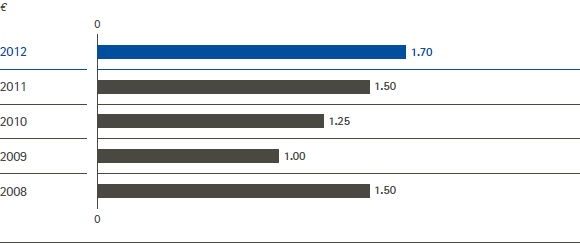
Lastly, Merck uses its cash to pay a dividend to its shareholders. For the coming years, Merck is aiming to distribute – based on current economic and business assumptions and subject to the approval of the Annual General Meeting – a dividend that is at least stable in absolute amounts compared to the dividend paid for the year 2011.
Dividend per share
 back
back