

Gross profit of the Merck Group improved in the first quarter of 2013 by 7.4% to € 2,036 million (Q1 2012: € 1,896 million), resulting in an increase in gross margin to 76.5% (Q1 2012: 74.0%). Both the lower level of inventory write-downs and changes in the product mix resulting from the good sales development of comparatively high-margin biotech products from the Merck Serono division had a noticeably positive effect.
Marketing and selling expenses decreased by 3.1% to € 568 million (Q1 2012: € 587 million), mainly as a result of the efficiency improvement measures implemented in the Merck Serono division. By contrast, royalty, license and commission expenses rose 13.6% to € 136 million (Q1 2012: € 120 million) primarily due to the good development of Rebif® sales in the United States.
On March 7, 2013, Merck provided a status report on the savings generated by the “Fit for 2018” efficiency program as well as the associated costs. According to this update, the good progress achieved so far has made it possible to reach the savings targets faster than planned. This is in turn has affected the outlook for the coming years. For 2013, Merck is now assuming it will achieve further savings of around € 165 million compared to 2012 while incurring related expenses of about € 230 million. Compared to 2011, improvements in the cost structure shall lead to sustainable cost savings of € 385 million by 2017, for which expenses of around € 820 million are expected. In the first quarter of 2013, one-time items totaling € 47 million were reported, including € 42 million related to “Fit for 2018” (Q1 2012: € 21 million, € 11 million of which was attributable to “Fit for 2018”). This led to a 27.3% increase in other operating expenses to € 184 million (Q1 2012: € 145 million).
Research and development spending rose 6.4% to € 406 million. (Q1 2012: € 382 million). This increase was due mainly to Merck Serono as well as to higher R&D investments in the Merck Millipore division.
In the first quarter, amortization of intangible assets declined by 3.1% to € 210 million (Q1 2012: € 216 million). This reflects the end of the amortization of an asset acquired within the scope of the Serono purchase.
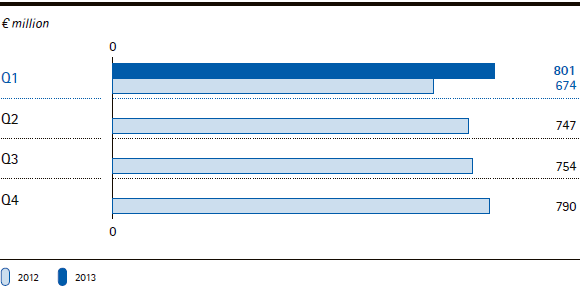
Selling, general and administration (SG&A*) costs, which were slightly higher overall, as well as research and development costs, only had a minor impact on the sharp increase in gross profit. The operating result (EBIT) thus soared by 28.6% to € 399 million (Q1 2012: € 311 million) and the EBIT margin rose to 15.0% (Q1 2012: 12.1%). Earnings before interest, taxes, depreciation and amortization (EBITDA) also grew by 15.4% to € 754 million (Q1 2012: € 653 million). Adjusted for one-time items, EBITDA pre rose by 18.8% to € 801 million € (Q1 2012: € 674 million), equivalent to 30.1% of sales. With this, the 30% mark was exceeded for the first time (Q1 2012: 26.3%).
The financial result of the Merck Group improved in the first quarter of 2013 by 11.2% to € -59 million (Q1 2012: € -66 million). This was mainly the result of the € 1 billion decline in financial liabilities compared with the beginning of the year-ago quarter following the repayment in March and December 2012 of two bonds that were each worth € 500 million.
Income taxes totaled € -72 million, which was 3.3% more than in the year-earlier quarter (Q1 2012: € -69 million). This corresponds to a tax ratio of 21.0% (Q1 2012: 28.4%).
The sharp increase in EBIT, coupled with lower interest expenses and a comparatively low tax burden, led to a significant improvement in net income in the first quarter of 2013. Net income, i.e. profit after tax attributable to Merck shareholders, soared by 54.1% to € 266 million (Q1 2012: € 173 million), translating into earnings per share of € 1.22 (Q1 2012: € 0.79). Before one-time items, earnings per share climbed by 27.1% to € 2.11 (Q1 2012: € 1.66).
*SG&A costs comprise: marketing & selling, royalty, license and commission expenses, administration as well as other operating expenses and income.
Merck Group | EBITDA pre one-time items by quarter
Free cash flow (net cash flow from operating activities less acquisitions/divestments, purchase/disposals of intangible assets, property, plant and equipment, non-current financial assets and marketable securities) rose 4.5% to € 439 million (Q1 2012: € 420 million) despite considerable negative effects. These included, for instance a cash outflow of about € 100 million related to “Fit for 2018”. In addition, the expansion of business in the Emerging Markets region, where longer payment terms are common, caused working capital to increase by € 195 million to € 2,562 million, corresponding to 23.6% of sales over the past twelve months.
 search hit 12
