The Merck share price showed strong fluctuations. EUR 3.2 billion euro bond successfully issued.
Stock market recovery continues
The recovery that began in the first half of 2009 in the international stock markets continued in 2010. This was attributable to several factors, including the further recovery of the global economy, persistently low interest rates set by the leading international central banks, as well as expansionist monetary policies, especially in the United States. However, the after-effects of the global banking crisis that escalated in 2008 had a significant impact on the budgets of a number of eurozone members. Government bond yield spreads increased sharply, prompting the European Central Bank to issue an unprecedented level of guarantees. This also had an impact on the euro, the value of which declined significantly against all international reserve currencies for a time. By contrast, the market for corporate bonds proved to be much more stable, benefiting from high demand despite comparatively low coupons.
The performance of Merck shares vs. the DAX® and Bloomberg Europe Pharmaceuticals Index in 2010
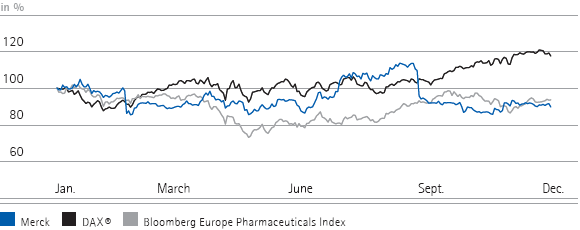
Development of the key indices
With the DAX®, Germany’s blue-chip index of the 30 largest German stock corporations by free float market capitalization and trading volume, climbing to well over 6,000 points, the German stock market got off to a strong start in 2010. Growing concerns about the credit ratings and liquidity of a number of EU member states – especially Greece and Ireland – damped market sentiment several times throughout the year, in some cases severely. However, the intervention by European monetary authorities repeatedly proved capable of reassuring market participants. The DAX® hit an annual low of 5,434 points on February 5, reached its high of 7,078 points on December 21, and finished the year on December 31 at 6,914 points, a 16% increase for the full year. The development of the BEUPHRM Index (Bloomberg Europe Pharmaceuticals Index), which comprises 22 selected European pharmaceutical companies, was quite different. The annual high of 103.44 points was achieved on January 19, while the low for the year of 81.59 points was reached on May 25. This was primarily attributable to the declines in the share prices of index heavyweights such as AstraZeneca, GlaxoSmithKline, Novartis, and Sanofi-Aventis, which together account for far more than half of the index’s weighting. By October 15, the BEUPHRM had nearly recovered from these losses, closing at 100.98 points. However, with a decline of 3.4% as of year-end (December 31: 97.13 points), it remained well behind the development of the DAX®.
 back
back