

Merck Serono, which discovers, develops, manufactures and markets prescription medicines of both chemical and biological origin, is the largest division of the Merck Group, accounting for 56% of Group total revenues.
|
Merck Serono | Key figures |
|
|
|
|
|
|
|
EUR million |
Q1 – 2011 |
Q1 – 2010 |
|
Total revenues |
1,427.2 |
1,406.8 |
|
Gross margin |
1,221.6 |
1,186.5 |
|
Research and development |
–305.6 |
–304.4 |
|
Operating result |
148.4 |
178.0 |
|
Exceptional items |
1.0 |
– |
|
Free cash flow |
538.2 |
191.4 |
|
Underlying free cash flow |
273.1 |
191.4 |
|
ROS in % |
10.4 |
12.7 |
Business development
Merck Serono’s total revenues increased 1.5% to EUR 1,427 million in the first quarter of 2011 compared to EUR 1,407 million in the year-ago quarter. The growth rate is less than usual because sales of the multiple sclerosis treatment Rebif®, Merck Serono’s top-selling product, and other drugs were inordinately high in the comparable quarter last year when U.S. wholesalers received an extra 20 days supply of products. This was to prevent a possible shortage in April while the EMD Serono subsidiary in the United States converted its computer system.
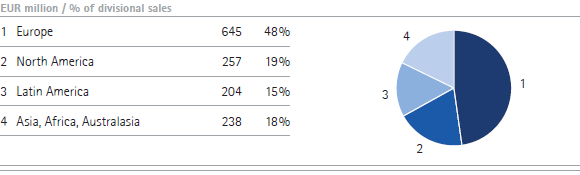
The sales shift inevitably resulted in a sales decline in North America. Sales in Europe also declined, mainly due to the divestment of the Théramex women’s health business and healthcare policy changes in Germany. On the other hand, sales in Latin America and Australasia showed a robust growth.
Royalty, license and commission income rose in the first quarter by 17% to EUR 82 million.
Merck Serono | Sales by region – Q1
Merck Serono’s primary care products continue to contribute significantly to the division’s overall sales. Sales of the branded Concor® (bisoprolol) beta blocker products, such as Lodoz® and Concor®COR, increased 4.1% to EUR 95 million in the first quarter. Total sales of the Glucophage® (metformin) franchise of oral antidiabetic products rose 6.0% to EUR 81 million in the first quarter. Sales of thyroid medicines such as Euthyrox® jumped 20% to EUR 46 million in the first quarter due to growth in Europe, Latin America and Australasia.
With an increase in total revenues and a decrease in the cost of sales, the division’s gross margin rose by 3.0% to EUR 1,222 million in the first quarter. Marketing and selling costs rose in the first quarter by 9.2% to EUR 352 million from EUR 322 million in the comparatively low first quarter of 2010. Royalty, license and commission expenses were down 9.1% due to a decline in commission payments on sales of Rebif®.
The division’s first-quarter ROS was 10.4% compared to 12.7% in the year-ago quarter. Core ROS, which excludes Serono-related amortization of intangible assets, was 24.3% in the first quarter of 2011 compared to 22.4% in the year-ago quarter. Free cash flow grew almost threefold to EUR 538 million in the first quarter of 2011 compared to EUR 191 million in the year-ago quarter mainly due to the payments received on the divestment of the Théramex business.
In January, the Committee for Medicinal Products for Human Use (CHMP) confirmed its previous position and adopted a final negative opinion regarding the European marketing authorization application for Cladribine Tablets as a treatment for relapsing-remitting multiple sclerosis. In March, the division received a letter from the U.S. Food and Drug Administration (FDA) saying the new drug application for Cladribine Tablets could not be approved in its present form. Merck Serono will meet with the FDA in May to clarify next steps and to identify whether data from completed and ongoing clinical studies can address the FDA’s questions. The resulting uncertainty about the future prospects of Cladribine Tablets at this point in time led to an impairment of the remaining EUR 50 million book value on this product. Thus, the division’s charge for amortization of intangible assets from the 2007 acquisition of Serono increased to EUR 199 million in the first quarter of 2011.
Consequently, the division’s first-quarter operating result declined by 17% to EUR 148 million from EUR 178 million in the year-ago quarter. The core operating result, which excludes Serono-related amortization of intangible assets, increased by 10% to EUR 347 million compared to EUR 316 million in the first quarter of 2010.
Therapeutic areas
At EUR 411 million, global sales of Rebif® for the treatment of relapsing forms of multiple sclerosis, returned to normal levels in the first quarter of 2011. However, this represented a decline of 4.2% due to the spike in sales in the year-ago quarter as previously discussed.
Sales of the targeted cancer treatment Erbitux® continued to climb, increasing by 8.7% in the first quarter to EUR 209 million with a generally solid performance in Merck Serono markets except Japan.
First-quarter sales of Gonal-f®, a recombinant hormone used in the treatment of infertility, decreased by 4.2% to EUR 133 million, also suffering from the above mentioned spike in Q1 2010.
Sales of the recombinant growth hormone Saizen® for growth hormone deficiency rose by 1.3% to EUR 55 million in the first quarter.
Research and development
Research and development spending by Merck Serono rose 0.4% to EUR 306 million. The division’s R&D costs equaled 21% of revenues due to cost-intensive, late-stage clinical trials.
During March, Merck Serono submitted an indication extension application to the European Medicines Agency (EMA) to expand the range of indications for Erbitux® to include the treatment of patients with advanced or metastatic non-small cell lung cancer with high epidermal growth factor receptor (EGRF) expression in combination with standard first-line platinum-based chemotherapy. The submission is based on a new biomarker analysis of EGFR expression levels in tumors of patients participating in the Phase III FLEX study.
Recruitment of more than 870 patients was completed for the pivotal Phase III EXPAND clinical trial investigating Erbitux® in the treatment of patients with advanced gastric cancer.
 back
back
