

Merck Serono discovers, develops, manufactures and markets prescription medicines of both chemical and biological origin. It is the largest division of the Merck Group, accounting for 58% of Group total revenues in the second quarter.
|
Merck Serono | Key figures |
|
|
||
|
|
|
|
|
|
|
€ million |
Q2 – 2011 |
Change |
Jan.–June |
Change |
|
Total revenues |
1,479.9 |
2.0 |
2,907.1 |
1.7 |
|
Gross margin |
1,186.9 |
–2.6 |
2,408.5 |
0.1 |
|
Research and development |
-301.3 |
1.7 |
–606.9 |
1.1 |
|
Operating result |
-146.6 |
– |
1.8 |
–99.5 |
|
Exceptional items |
5.8 |
– |
6.8 |
– |
|
Free cash flow |
155.1 |
–39.8 |
693.3 |
54.4 |
|
Underlying free cash flow |
149.8 |
–41.8 |
423.0 |
–5.8 |
|
ROS in % |
-9.9 |
|
0.1 |
|
Business development
Merck Serono’s total revenues during the second quarter increased 2.0% to € 1,480 million compared to € 1,451 million in the year-ago quarter. In the first half of 2011, revenues rose 1.7% to € 2,907 million.
The division’s second-quarter organic sales growth of 8.0% was reduced by 2.9 percentage points due to negative currency effects and a further 1.6 percentage points due to divestments. This resulted in a nominal sales growth rate of 3.4%. The division’s growth rate also benefited from a low base in the second quarter of 2010. Approximately € 50 million of sales were pulled forward into the first quarter of 2010 to build inventories in the United States for the second quarter.
Sales in Europe declined slightly owing to the divestment of the Théramex women’s health business. North American sales were up, mainly due to lower sales in the year-ago quarter. Sales in Latin America and Australasia showed robust growth. In particular, sales in China jumped 21% and sales in India were up 19%.
Royalty, license and commission income declined in the second quarter by 17% to € 84 million. For the first half of 2011, royalty, license and commission income declined by only 3.1% to € 167 million.
Merck Serono | Sales by region – Q2
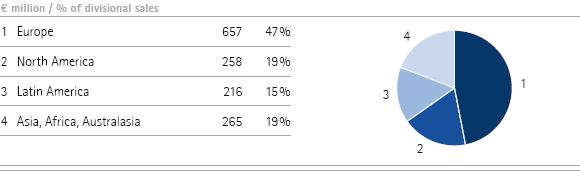
Merck Serono’s primary care products continue to contribute significantly to the division’s overall sales. Sales of the branded Concor® (bisoprolol) beta blocker products, such as Lodoz® and Concor®COR, increased 7.6% to € 106 million in the second quarter. Total sales of the Glucophage® (metformin) franchise of oral antidiabetic products jumped 22% to € 92 million in the second quarter due to strong demand in Latin America and Asia. Sales of thyroid medicines such as Euthyrox® rose 10% to € 52 million in the second quarter.
The division’s cost of sales, which included one-time inventory adjustments of € –13 million, rose 26% in the second quarter. This resulted in a 2.6% decline in the gross margin to € 1,187 million. Marketing and selling costs were down 3.2% to € 367 million. Royalty, license and commission expenses were basically unchanged.
In the normal portfolio review process, the division identified € 292 million of one-time charges for the second quarter.
Of this amount, € 161 million relates to an impairment of the Corsier-sur-Vevey Large Scale Biotech (LSB) production plant in Switzerland due to overcapacity. This re-assessment of capacity needs was triggered by the completion of construction and the beginning of the testing phase at the plant.
Other one-time charges include: € 63 million related to changes in the development plan for the Parkinson’s drug safinamide; € 35 million stemming from the decision to stop the development of the drug candidate IMO-2055 in combination with chemotherapy and Erbitux® in patients with first-line squamous cell carcinoma of the head and neck (SCCHN); a provision of € 20 million on the remaining costs associated with halting the development of cladribine, a drug candidate for the oral treatment of multiple sclerosis; and € 13 million for inventory adjustments. In addition, the reduction of the amortization period of Rebif® by two years, reflecting the impact of oral multiple sclerosis drugs entering the market, resulted in an incremental amortization charge of € 17 million in the second quarter.
Due to the one-time impairment losses and other costs mentioned above, the Merck Serono division recorded an operating result of € –147 million for the second quarter compared to € 164 million in the year-ago quarter. The second-quarter core operating result, which excludes amortization of intangible assets, declined to € 116 million from € 307 million in the year-ago quarter. For the half year, the operating result was € 1.8 million in 2011 and € 342 million in 2010, while the core operating result was € 464 million in 2011 and € 622 million in 2010.
The division’s second-quarter ROS was –9.9% compared to 11.3% in the year-ago quarter. Core ROS, which excludes Merck Serono-related amortization of intangible assets, was 7.8% in the second quarter of 2011 compared to 21.1% in the year-ago quarter.
In July, Merck Serono announced that is strengthening its executive management team with two appointments: Dr. Belén Garijo to Chief Operating Officer and Dr. Annalisa Jenkins as Global Head of Drug Development & Medical. Both will join Merck in September.
Therapeutic areas
Global sales of Rebif® for the treatment of relapsing forms of multiple sclerosis rose 5.2% to € 423 million in the second quarter or 11% on an organic basis. The increase is largely due to a 13% jump in North American sales that mainly resulted from lower than normal sales in the year-ago quarter when U.S. wholesalers received an extra 20 days supply of products in the first quarter. This was to prevent a possible shortage in April while the U.S. subsidiary converted its computer system.
Sales of the targeted cancer treatment Erbitux® declined by 3.0% in the second quarter to € 204 million mainly due to a sales decline in Japan. This decline is related to a slower than expected implementation of the KRAS biomarker testing required in line with the label extension from third-line to first-line treatment of metastatic colorectal cancer and strong competition. Sales in Asia excluding Japan and sales in Latin America continued to rise while sales in Europe were flat due to cost-containment measures by payers.
Second-quarter sales of Gonal-f®, a recombinant hormone used in the treatment of infertility, increased by 7.2% to € 130 million due to high demand in Asia, Africa and Australasia. This increase reflects an organic sales growth rate of 11%.
Sales of the recombinant growth hormone Saizen® for the treatment of growth-hormone deficiency declined by 5.4% to € 55 million in the second quarter. Organically, sales declined 1.3%.
Research and development
Research and development spending by Merck Serono rose 1.7% to € 301 million in the second quarter and by 1.1% to € 607 million in the first half of the year.
Merck announced during the second quarter that patient enrollment in the global pivotal Phase III clinical study CENTRIC had been completed. This study was designed to assess the efficacy and safety of the investigational integrin inhibitor cilengitide in combination with standard treatment in a biomarker-defined subgroup of newly diagnosed patients with glioblastoma. More than 500 patients were recruited. The primary endpoint of the study is overall survival.
In late June, Merck submitted an application to the European Medicines Agency (EMA) to extend the indication of Rebif® for its use in patients who have experienced a single demyelinating event, an early sign of multiple sclerosis, and who are at high risk of converting to the disease.
 back
back
