back
back
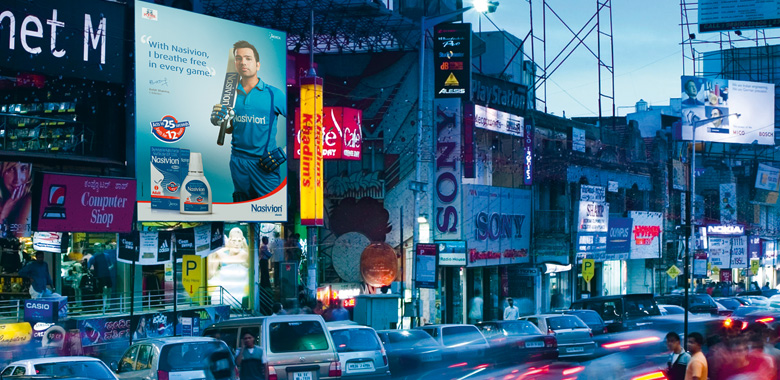
Breathing easy thanks to Nasivin®. A clever direct-to-consumer strategy is getting the message out there – even in the hectic environment of rush hour in India.
In India, a nasal spray is more than just medicine. It is also a fast way to get back to work.
Thanks to innovative ideas and a clever marketing strategy, Merck is benefiting from a new degree of health awareness on the subcontinent.
- Interview with Udit Batra
- At a glance
Interview with Udit Batra
Udit Batra discusses the growing degree of health awareness among the middle class in India.
And how taxis and pharmacists are playing a key role in the success of a nasal spray.

Udit Batra President and CEO of Consumer Health
“In India, people want quick relief so that they can get back to enjoying life.”
Mr. Batra, isn’t a head cold the same everywhere, whether in India or Iceland?
That may be the case from a medical perspective, but patients have a different view. When an Indian and an Icelander are suffering from a cold, they have two completely different ways of handling it. After all, a cold impacts everyone differently. And that applies to all patients in the more than 20 countries in which we successfully market Nasivin®.
Patients in India are increasingly arming themselves with Nasivin® – why?
In India, people want quick relief so that they can get back to enjoying life, which is why they are looking for fast-acting, easy-to-use medicines. Consumers in India are also inquisitive and open to innovative ideas and are becoming increasingly health-conscious …
...which, thanks to a growing middle class and higher purchasing power, makes India a more and more attractive market for Merck.
Precisely, although we are not exactly newcomers to the market in India. We have been marketing Nasivin® on the subcontinent since 1969, first with the nasal spray for adults. In the 1980s and 1990s, we then expanded our portfolio and launched sprays for babies and small children. This is how we became the second biggest brand in the topical nasal decongestants category, and since 2010 we have been taking the direct-to-consumer approach: clear key messages and revamped packaging so as to appeal to consumers and drive clear and targeted messages at various consumers touch points.
Is that why 50 “Nasivin® taxis” are plying the route between Delhi Airport and downtown Delhi, and two double-decker Nasivin® buses are driving around Mumbai?
Exactly so. These are both examples of our Metro Campaign for our new product Nasivin® Advanced, which is highly innovative and is focused on consumer needs. This is a nasal spray that, apart from acting quickly, also soothes thanks to the addition of aloe vera, menthol and eucalyptol. Moreover, the buses and taxis are also good examples of our rainbow strategy in India.
Rainbow strategy?
20%
average annual growth rate in India since 2011
With this strategy, we are additionally addressing health care professionals such as physicians and pharmacists, who prescribe or recommend Nasivin® to our consumers. For us, it goes beyond merely prescribing the medicine; it’s also about convincing doctors and pharmacists to act as brand ambassadors as well as increasing point-of-sale visibility – always based on an entirely unique, individual positioning, which of course reflects Consumer Health’s overall strategy in India.
What does that actually mean for point-of-sale activities?
In India, pharmacist recommendations play a key role in the marketing mix. They do not just sell medicine, but are also people whom consumers trust and are often considered friends. If you want to be successful, you must therefore convince the pharmacist of your product.
And has Merck been able to convince people in India of Nasivin®?
In the last three years, Nasivin® has seen an average annual growth rate of 20%; in a market totaling INR 1.3 billion (around € 15.4 million) with more than 30 different brands, this growth is the best proof that we have attractive products in our portfolio.

In the Indian market, 30 products are generating strong growth for Merck. These include Nasivion® (known as Nasivin® in Germany), which is being supported by a comprehensive advertising strategy.
At a glance
Consumer Health
The Consumer Health division offers high-quality over-the-counter pharmaceuticals to enhance well-being. Our brands are marketed in many countries of Europe, Latin America, Asia and Africa. With our innovative health protection products, we want to improve the quality of life of people everywhere.
The brands
Bion®
Cebion®
Femibion®
Kytta®
Nasivin®
Seven Seas®
Sangobion®
Sedalmerck®
These are the names of some of the many successful brands in Consumer Health. Our product Bion® is the world’s leading probiotic multivitamin.
Business figures
Sales
€ 476,915,464
EBITDA pre
€ 72,450,063
Sales by region

Microcosmos
Nasivin®
In the early 1960s, Merck launched Nasivin®, the first nasal decongestant containing the active ingredient oxymetazoline. In the following decades, Nasivin® came to stand for cold treatments.
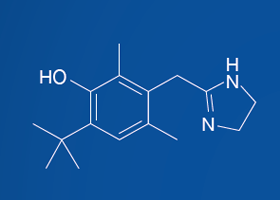
01 Formula
Oxymetazoline is a chemical compound, specifically an imidazole derivative. It is used as a nasal decongestant.
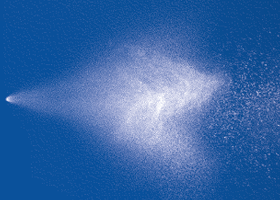
02 Substance
Small drops, big effect: the blood vessels of the nose constrict, swelling of the nasal mucosa recedes. Thanks to oxymetazoline, the duration of an acute cold is shortened by a third.
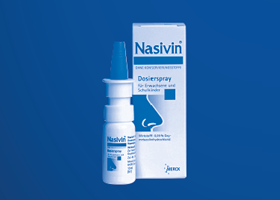
03 Dosage system
High ergonomic quality thanks to the large push button on the base, the antislip ridges on the shoulder, and the user-friendly applicator.
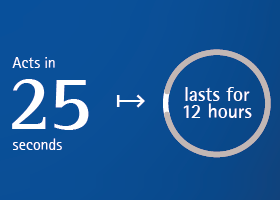
04 Nasivin®
Acts in 25 seconds and lasts for up to 12 hours. Normally, administration two to three times per day suffices.