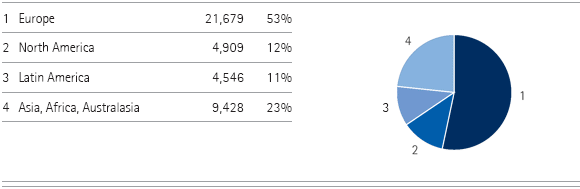
As of December 31, 2010, our company had 40,562 employees, which was 7,500 more than in 2009. Merck was represented in 67 countries by 236 companies and had 70 production sites located in 26 countries.
The change in the number of employees was mainly a result of our acquisition of the life science company Millipore, which we completed in July 2010. The following countries saw significant increases in the workforce in connection with this acquisition: In the United States 2,712 employees came from Millipore to Merck, in France 1,323, in Ireland 484, in India 272, in Japan 204, in China 188, in The Netherlands 153, and in Brazil 105.
In Germany, Merck had 10,340 employees, which was 436 more than in 2009. Here, the increase was attributable to research and development in the Merck Serono division, to chemical production, to the establishment of a global purchasing organization, and to the addition of Millipore employees in Germany. Merck Serono in China had 1,230 employees, 333 more than in 2009, as the division opened a new research center there and also expanded its sales and marketing activities.
A total of 512 young people were enrolled in vocational training programs in 19 different occupations at the Darmstadt site, the largest of the Merck Group.
Number of employees as of December 31, 2010
Integration of Millipore employees
The acquisition of Millipore gives Merck the possibility to strengthen its position in the attractive life science market and at the same time to expand its geographic reach. Therefore, the expertise and skill of the Millipore employees as well as their commitment are key to the success of this business. Right from the start of the integration process, we made sure when appointing people to positions that the management teams of the new Merck Millipore division could optimally draw on the expertise of both companies. Further key features of the integration process included regular, open communication, change management activities that take specific corporate cultures into account, and concepts designed to maintain employee loyalty.
 back
back