At Merck, the pharmaceutical, chemical and life science businesses are under one roof. We are convinced that in these sectors, the market will reward successful research and technological advances with attractive margins. We focus on specialty businesses. We are not interested in engaging in commodity markets or businesses where competition is dictated by price alone.
The Merck path
It all started with a pharmacy in 1668. The Angel Pharmacy, which is still owned by members of the Merck family, is where Merck originated. Like his contemporaries, the pharmacist Friedrich Jacob Merck prepared all medicinal substances himself. At that time, the “art of pharmacy” was still a manual craft.
In 1816 – several generations of pharmacists later – Emanuel Merck took over his father’s pharmacy and initiated the move from a manual craft to industrial production in 1827. In his laboratory, he succeeded in extracting pure alkaloids, a class of highly effective plant constituents whose medicinal effect attracted interest from the scientific community. By 1860, the company already offered more than 800 organic and inorganic substances for sale, including many still used in laboratories today.
The roots of the Liquid Crystals business – one of the outstanding Merck success stories – date back to 1904. For decades, liquid crystals remained a laboratory oddity, and their sale was handled by the Laboratory business.
Serono, which was acquired by Merck in 2007, also started out by extracting active substances. In 1906, Cesare Serono founded the “Istituto Farmacologico Serono” in Rome and developed a new method of extracting lecithin from egg yolk. In 1949, the company successfully isolated pure gonadotropin from urine. Gonadotropin plays an important role in reproduction. The production of recombinant gonadotropin transformed Serono into a biotechnology company.
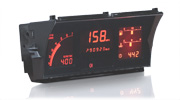
Merck is the market leader for
liquid crystals. By 1983, they were
being used in car dashboards.
Becoming a global, publicly listed company
Merck established initial business relationships with European neighbors in the 1820s. Since 1900, Merck has maintained business relationships on all continents.
In the United States, Georg (later “George”) Merck, a grandson of Emanuel Merck, founded a trading company called Merck & Co. in 1891. As a result of World War I, Merck in Darmstadt lost its entire stake in this company under the “Trading with the Enemy Act” of 1917. George Merck succeeded in reacquiring his interest and became president of the public company Merck & Co. Today, the two companies are no longer linked. The U.S. company Merck & Co. owns the exclusive rights to the name within North America while Merck in Darmstadt holds the rights in the rest of the world. In the United States and Canada, the company operates under the name EMD, the abbreviation for Emanuel Merck, Darmstadt.
Acquisitions and divestments have always played an important role at Merck. A decisive step in Merck’s expansion was the acquisition of a 50% interest in the Bracco Group of Italy in 1972. Aside from commercializing contrast agents and its own pharmaceutical specialties, Bracco served as Merck’s representative in Italy for the entire Merck product range, helping to significantly boost Merck’s earning power. In 1991, Merck acquired the French company Société Lyonnaise Industrielle Pharmaceutique (Lipha). In the mid-1990s, Merck expanded its consumer health care business by acquiring Seven Seas in the United Kingdom and Monot in France. At the same time, the acquisition of Amerpharm of the United Kingdom gave Merck a critical mass in the generic drugs business. The takeover of a large number of laboratory distribution businesses was rounded off with the purchase of VWR Scientific Products, a U.S. laboratory distributor, in 1999.
In order to secure the financing of these acquisitions, Merck went public in 1995. A 26% interest in Merck KGaA was sold to shareholders. The Merck family held the remaining 74% via the general partner E. Merck. Following a capital increase in 2007, the ownership ratio shifted to its current 30–70 ratio.
The first half of the past decade saw a significant number of divestments. In 2000, Merck divested its interest in Bracco and vitamin chemicals. In 2004, the company exited from the Laboratory Distribution and Electronic Chemicals businesses. In 2006, Merck was debt-free.
In 2007, Merck embarked on a growth course, acquiring the Swiss biopharmaceutical company Serono. Involving a purchase price of EUR 10.3 billion, this was by far the largest acquisition ever made by Merck. As the generics business was sold in the same year for EUR 4.9 billion, the company lowered its debt to less than EUR 1 billion by year-end. Only three years later, Merck made its next major acquisition, purchasing Millipore for EUR 5.1 billion. The EUR 3.2 billion bond issue was the largest euro-bond offering by a German company in 2010. Merck also decided to divest two non-core businesses in 2010: Théramex, a company specializing in women’s health, and the Crop BioScience business for improving plant health and crop yields.
 back
back