Sales by the Merck Serono division grew far more strongly than the forecasted average for the pharmaceutical industry. Nearly two-thirds of this growth is attributable to the biopharmaceuticals Rebif® and Erbitux®.
|
Merck Serono | Key figures |
|||
|
|
|
|
|
|
EUR million |
2010 |
2009 |
Δ in % |
|
Total revenues |
5,754 |
5,345 |
7.6 |
|
Gross margin |
4,793 |
4,485 |
6.9 |
|
R&D |
1,167 |
1,184 |
–1.4 |
|
Operating result |
565 |
355 |
59 |
|
Exceptional items |
69 |
–40 |
– |
|
Free cash flow |
1,298 |
864 |
50 |
|
Underlying free cash flow |
1,308 |
867 |
51 |
|
ROS in % |
9.8 |
6.6 |
|
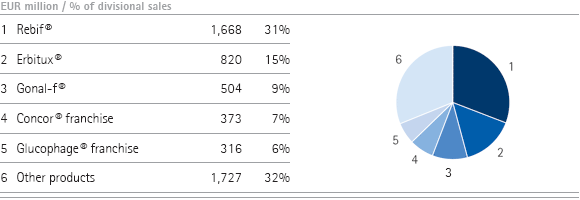
In 2010, the Merck Serono division increased total revenues by 7.6% to EUR 5,754 million. Sales increased by 8.3%, with positive currency effects accounting for 2.6% of the increase. This excellent growth, which exceeded the sector average of 4% to 5% estimated by IMS Health, was once again due to the success of our biopharmaceuticals. We generated EUR 3,288 million or 61% of our sales with our five top-selling biopharmaceuticals Rebif®, Erbitux®, Saizen®, Gonal-f® and Serostim®. Rebif®, a treatment for relapsing-remitting multiple sclerosis, was once again the top-selling product, with sales increasing by 8.6% to EUR 1,668 million. Erbitux®, our targeted cancer therapy, posted another double-digit increase in sales, which rose by 18% to EUR 820 million. In March, Erbitux® received approval in the key market of Japan for extended usage in combination with chemotherapy for the first-line treatment of metastatic colorectal cancer (KRAS wild-type tumors). Cladribine tablets (brand name Movectro®) were approved in Russia in July, becoming the world’s first oral disease-modifying treatment for relapsing-remitting multiple sclerosis. Approval in Australia followed in September. In November, the U.S. Food and Drug Administration granted approval of Egrifta™ (tesamorelin for injection) to reduce excess abdominal fat in HIV-infected patients with lipodystrophy.
Our five top-selling drugs by sales in 2010
At EUR 344 million, royalty, license and commission income was slightly below the previous year’s level. In comparison with 2009, the division’s gross margin increased by 6.9% to EUR 4,793 million. Due to strong exchange rate effects and investments in new products and emerging markets such as China, marketing and selling expenses were 10% higher than in 2009. Research and development costs declined moderately by 1.4% to EUR 1,167 million. In total, non-recurring expenses were lower than in 2009. The largest single non-recurring item was the impairment loss for safinamide. Overall, the operating result improved by 59% to EUR 565 million. Return on sales (ROS) increased to 9.8% in 2010. Underlying free cash flow grew by 51% to EUR 1,308 million.
 back
back