

Merck Serono’s third quarter total revenues rose 10.5% to € 1,623 million (Q3 2011: € 1,469 million), including an increase in sales of 9.9% to € 1,511 million (Q3 2011: € 1,375 million). This solid performance was driven by an organic sales growth of 5.3% and improved a further 4.6% because of changes in foreign exchange rates. The foreign exchange rate benefit was primarily the result of a stronger US dollar in Q3 2012 compared to Q3 2011. From a product perspective, sales growth was once again led by the company’s Multiple Sclerosis product, Rebif®, its leading Fertility product, Gonal-f®, and its diabetes product Glucophage®, all of which grew organically at double-digit rates. Each of these products benefited from higher volumes, with the first two being additionally supported by price increases. Royalty, license and commission income improved 19.7% to € 112 million (Q3 2011: € 94 million) as a result of changes in foreign exchange rates as well as higher royalty income related to a strong sales performance of Humira®, which is marketed by Merck’s licensee Abbott Laboratories.
| XLS |
|
Merck Serono | Key figures | ||||||
|
|
|
|
|
|
|
|
|
|
|
|
|
|
|
|
|
€ million |
Q3 2012 |
Q3 2011 |
Change |
Jan.–Sept. 2012 |
Jan.–Sept. 2011 |
Change |
|
Total revenues |
1,623.0 |
1,468.8 |
10.5% |
4,767.0 |
4,375.9 |
8.9% |
|
Sales |
1,510.6 |
1,374.9 |
9.9% |
4,474.3 |
4,115.3 |
8.7% |
|
Operating result (EBIT) |
142.7 |
177.6 |
–19.6% |
298.4 |
192.3 |
55.2% |
|
Margin (% of sales) |
9.4% |
12.9% |
|
6.7% |
4.7% |
|
|
EBITDA |
373.1 |
392.8 |
–5.0% |
1,004.8 |
1,134.7 |
–11.5% |
|
Margin (% of sales) |
24.7% |
28.6% |
|
22.5% |
27.6% |
|
|
EBITDA pre one-time items |
456.1 |
392.8 |
16.1% |
1,289.1 |
1,160.7 |
11.1% |
|
Margin (% of sales) |
30.2% |
28.6% |
|
28.8% |
28.2% |
|
During the third quarter of 2012, the division’s production costs rose 18.6% to € 288 million (Q3 2011: € 243 million) reflecting increased volumes as well as higher start-up costs for the division’s bioproduction plant in Vevey, Switzerland. Gross profit grew by 8.9% to € 1,335 million (Q3 2011: € 1,226 million). This translated into a gross margin (as percentage of sales) of 88.4% (Q3 2011: 89.2%).
Marketing and selling costs declined by 1.2% to € 339 million (Q3 2011: € 343 million) due to a focus on more efficient resource allocation, particularly for discretionary costs. However, royalty, license and commission expenses rose 22.2% to € 157 million (Q3 2011: € 128 million), mainly due to the strong performance of Rebif® in the United States that triggered higher commission payments to the the division’s co-marketing partner Pfizer.
Other operating expenses more than tripled to € 178 million (Q3 2011: € 52 million) largely driven by one-time items, in particular expenses of € 82 million related to restructuring measures for the Group’s efficiency program. In addition, the division reported costs of € 11 million in Q3 2012 mainly related to software impairments. Finally, a write-off of receivables triggered by the insolvency of Germany’s largest mail-order pharmacy contributed to the increase in other operating expenses.
Merck Serono’s investments into research and development declined 3.2% to € 287 million in the quarter (Q3 2011: € 297 million) as a result of lower clinical development costs also because two Erbitux® phase III trials were stopped in Q2 2012.
Amortization of intangible assets remained at last year’s level, increasing just 0.5% to € 165 million (Q3 2011: € 164 million), reflecting the regular run-rate for the division.
The division’s EBIT was € 143 million (Q3 2011: € 178 million), down 19.6% and substantially impacted by the increase in other operating expenses, while EBITDA declined 5.0% to € 373 million (Q3 2011: € 393 million). However, adjusting for € 83 million in one-time items, primarily relating to the division’s restructuring efforts, EBITDA pre one-time items increased by 16.1% to € 456 million, representing 30.2% of sales (Q3 2011: € 393 million, representing 28.6% of sales). This margin improvement of 160 basis points is the result of strong operational performance and lower discretionary spending.
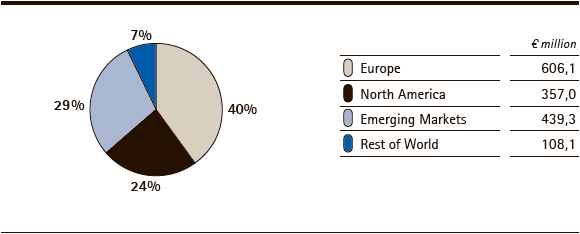
From a geographic perspective, the percentage of sales Merck Serono generated outside of Europe climbed to 60% in the third quarter of 2012 (Q3 2011: 56%). This was driven by the strong performance in North America, which reported an organic sales increase of 18.3% to € 357 million (Q3 2011: € 271 million), and represented 24% of the division’s sales (Q3 2011: 20%). The strongest growth contributor in the North American region was Rebif®, which benefited from both year-on-year price and volume increases. Sales in the Rest of World regions grew 9.9% organically to € 108 million (Q3 2011: € 92 million) with the biggest single growth driver being Glucophage®, the division’s diabetes treatment, due to continuing strong demand in Japan. Organic growth in the Emerging Markets softened to 4.4% and represented € 439 million of total sales for the division (Q3 2011: € 406 million). The softer growth rate in Q3 2012 was mainly due to lower sales in China which partially offset a strong performance in countries such as Brazil and Vietnam. The Emerging Markets benefited the most from a continued strong performance of the CardioMetabolic Care & General Medicine business unit, the Merck Serono fertility products and Erbitux®. Challenging business conditions in Europe, impacted by lower pricing as well as healthcare budget cuts, resulted in sales of € 606 million (Q3 2011: € 605 million), representing an organic sales decline of –0.7%.
Merck Serono | Sales by region – Q3 2012
On a product level, global sales of Merck’s largest single product, Rebif®, for the treatment of relapsing forms of Multiple Sclerosis, rose 10.2% organically to € 499 million (Q3 2011: € 426 million). The increase was mainly driven by 22.4% organic sales growth in the United States, which was the result of price increases and higher volumes. In Europe, organic sales growth of 2.1% reflected higher volumes offset by continued pricing pressure. Sales in the Emerging Markets declined compared to the same period in the previous year. However, the combined sales from the Emerging Markets and Rest of World accounted for less than 10% of this product’s global sales.
| XLS |
|
Merck Serono | Growth components by region – Q3 2012 | |||||
|
|
|
|
|
|
|
|
|
|
|
|
|
|
|
€ million/change in % |
Sales |
Organic |
Exchange rate effects |
Acquisitions/ |
Reported |
|
Europe |
606.1 |
–0.7% |
0.8% |
– |
0.1% |
|
North America |
357.0 |
18.3% |
13.2% |
– |
31.6% |
|
Emerging Markets |
439.3 |
4.4% |
3.8% |
– |
8.2% |
|
Rest of World |
108.1 |
9.9% |
7.5% |
– |
17.4% |
Sales of the biologic cancer drug Erbitux® remained flat on an organic basis at € 224 million (Q3 2011: € 218 million), largely due to a softer performance in Europe stemming from increasing competition in the second-line metastatic colorectal cancer segment as well as healthcare budget constraints. Higher sales in the Emerging Markets and the Rest of World regions offset the softness in Europe, with Rest of World benefiting from a strong performance in Australia triggered by reimbursement. In Japan, organic sales declined 6.0%. While Erbitux® sales in Japan are stabilizing and increased sequentially for the second straight quarter, the division continues to see competitive pressure in the region.
| XLS |
|
Merck Serono | Major products by region, organic growth rates – Q3 2012 | |||||||
|
|
|
|
|
|
|
|
|
|
|
|
|
|
|
|
|
|
|
|
|
Total |
Europe |
North America |
Emerging Markets |
Rest of World |
Change |
|
Rebif® |
€ million |
499.2 |
190.4 |
267.0 |
32.6 |
9.2 |
17.2% |
|
|
organic growth in % |
10.2% |
2.1% |
20.1% |
–6.1% |
19.3% |
|
|
|
% of sales |
100% |
38% |
53% |
7% |
2% |
|
|
Erbitux® |
€ million |
224.3 |
123.1 |
– |
60.7 |
40.5 |
3.0% |
|
|
organic growth in % |
– |
–2.5% |
– |
3.6% |
3.3% |
|
|
|
% of sales |
100% |
55% |
– |
27% |
18% |
|
Merck Serono | Organic sales growth by key product – Q3 2012
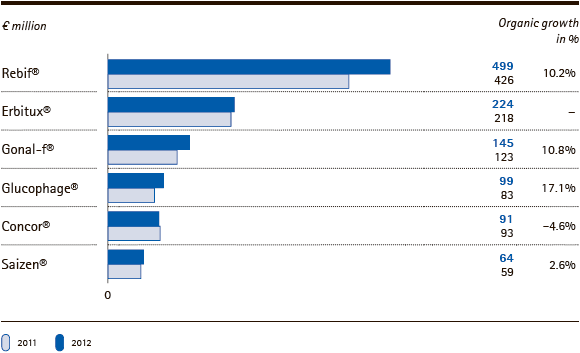
Sales of Gonal-f®, a recombinant hormone used in the treatment of infertility, continued to perform strongly, growing 10.8% organically in the third quarter of 2012 to € 145 million (Q3 2011: € 123 million), attributable to both volume and price increases. Sales continued to grow double-digit organically in all regions but Rest of World, helped by the continuous rollout of a family of ready-to-use injection pens.
The division’s Endocrinology business, dominated by products to treat metabolic and growth disorders, reported sales of € 102 million in the third quarter of 2012, representing organic sales growth of 7.2% (Q3 2011: € 90 million). The primary driver of organic sales growth continues to be Kuvan®, a product used for the treatment of hyperphenylalaninemia, a metabolic disorder. Kuvan® sales continue to grow rapidly in Europe while the rollout in Asia and Latin America remains ongoing. In addition, Egrifta®, used for the reduction of excess abdominal fat in HIV-infected patiens with lipodystrophy and which Merck Serono markets only in the United States, posted a strong double-digit increase in sales.
Sales of Merck Serono’s CardioMetabolic Care & General Medicine products inreased 0.8% organically to € 492 million (Q3 2011: € 477 million). Strong sales growth of Glucophage® as well as the thyroid medicines’ portfolio, used to treat hypothyroidism, offset softening sales of the beta-blocker Concor® that saw sharp pricing pressure in Europe, as well as increasing pressure on physicians to prescribe cheaper medications. In Emerging Markets, sales of Concor® continued to grow organically.
First Nine Months 2012 Performance
During the first nine months of 2012, the division’s total revenues climbed 8.9% to € 4,767 million (9M 2011: € 4,376 million), with sales increasing 8.7% to € 4,474 million (9M 2011: € 4,115 million). Reported sales reflected organic sales growth of 5.4% and a 3.4% boost from changes in foreign exchange rates. The primary driver of the organic sales growth was Rebif®, which generated organic sales growth of 7.6% and represented € 1,421 million in sales (9M 2011: € 1,260 million). Major driver of this organic sales growth was higher pricing in the US market. Erbitux®, the division’s second-largest product, saw an organic sales increase of 2.8%, representing € 664 million in sales (9M 2011: € 630 million). Softer sales in Europe and Japan were more than offset by high single-digit organic growth in the Emerging Markets and the remaining Rest of World regions. These two regions have grown to represent 43% of the product’s total sales.
The Fertility product portfolio with its biggest sales contributor Gonal-f® generated sales of € 608 million (9M 2011: € 510 million), representing organic sales growth of 14.8%. Gonal-f® generated strong volumes in all regions as well as a significant price increase in the United States. Endocrinology, the division’s business unit that markets drugs to treat metabolic and growth disorders, also posted solid organic growth of 12.2% through the first nine months, totaling sales of € 298 million (9M 2011: € 253 million). All products of the franchise increased sales organically, with mid-to-high double-digit growth rates generated by Egrifta® and Kuvan®. Finally, sales of the division’s Cardiometabolic Care & General Medicine products were flat organically with € 1,482 million in the first nine months of 2012 (9M 2011: € 1,459 million). Healthy volume growth in the Emerging Markets offset both pricing pressure as well as tougher generic competition in Europe.
The division’s EBITDA pre one-time items in the first nine months of 2012 increased 11.1% to € 1,289 million (9M 2011: € 1,161 million) driven by the strong top-line performance as well as more efficient resource allocation. Consequently, EBITDA pre one-time items as a percentage of sales increased to 28.8% (9M 2011: 28.2%).
Merck Serono Pipeline News in Q3 2012
On September 18, 2012, Merck announced the decision to voluntarily withdraw the marketing authorization application to the European Medicines Agency (EMA) of a label extension for Erbitux® in combination with standard first-line platinum-based chemotherapy in patients with advanced or metastatic non-small cell lung cancer (NSCLC) with high epidermal growth factor receptor (EGFR) expression. The decision to withdraw the application was based on feedback from EMA, indicating that further clinical data would be required. Merck will not pursue further development of Erbitux® in the lung cancer indication. These results do not alter the current utility of Erbitux® in patients with KRAS wild-type metastatic colorectal cancer (mCRC) and in patients with locally advanced or recurrent and/or metastatic squamous cell carcinoma of the head and neck (SCCHN) in those markets where Erbitux® is currently registered in these indications.
The division continues to strengthen its early- and mid-stage pipeline via strategic transactions. On September 6, 2012, Merck announced that an exclusive worldwide license agreement was signed with Symphogen A/S, Copenhagen, Denmark, for Sym004, potentially complementing and building upon Merck’s existing Erbitux® franchise. Sym004 is an investigational product comprised of two antibodies that are designed to block ligand binding, receptor activation and downstream signaling as well as to elicit removal of EGFR from the cancer cell surface by inducing their internalization and degradation. Sym004 is currently being evaluated in a Phase I/II trial in solid tumors, recently amended to focus on patients with advanced KRAS wild-type mCRC who have previously progressed on treatment with standard chemotherapy and a marketed anti-EGFR monoclonal antibody. In addition, a single-arm, open-label Phase II trial is on-going in patients with SCCHN who have failed anti-EGFR-based therapy.
In agreement with its partner Threshold Pharmaceuticals, Merck plans to initiate a randomized Phase III trial of the investigational hypoxia-targeted drug TH-302 in patients with advanced pancreatic cancer within the coming months. The decision to move into Phase III is based upon the results of a Phase II trial in the same population which showed a statistically significant improvement in progression free survival (PFS), the primary endpoint of the study, when TH-302 was used in combination with gemcitabine. At the European Society for Medical Oncology (ESMO) Congress in Vienna in September, new findings on overall survival (OS), which was a secondary endpoint of the study, were presented. The analysis and interpretation of the OS endpoint was confounded by the fact that for ethical reasons patients randomized to gemcitabine alone were allowed to cross-over to receive gemcitabine plus TH-302 upon disease progression. Nevertheless, patients treated initially with TH-302 and gemcitabine tended to have a longer OS than those treated with gemcitabine alone, although the difference was not statistically significant. Given the consistency in the PFS, and OS trends Merck and Threshold agreed that progression to a Phase III study in pancreatic cancer is warranted. The US affiliate of Merck has reached an agreement with the FDA regarding a Special Protocol Assessment (SPA) for this study. An SPA is a written agreement with the US Food and Drug Agency (FDA) that documents the agency’s agreement that the design and planned analysis of a study can adequately address objectives in support of a regulatory submission. However, FDA’s determinations for marketing application approval are made after a complete review of a marketing application and are based on all data in the application.
Turning to ONO-4641, the division’s sphingosine-1-phosphate receptor modulator, following the positive outcome from the Phase II DreaMS study in patients with relapsing Multiple Sclerosis presented in April 2012, further studies, both non-clinical and clinical, are being performed. Evaluation of data from these studies will provide more information on efficacy, safety and the potential for differentiation of this agent to allow Merck Serono to make an informed decision about whether to progress this project to Phase III in 2013.
Concerning Stimuvax, the division’s MUC1 antigen-specific immunotherapy, the outcome of the Phase III study (START) in over 1,500 patients with inoperable NSCLC (stage III loco-regional disease following first line chemo-radiotherapy) remains on track to deliver top-line results including the primary analysis of OS in the first quarter of 2013.
For cilengitide, Merck Serono’s integrin-targeting peptide, the outcome of the pivotal, randomized phase III study (CENTRIC) in 545 first-line glioblastoma patients with methylated MGMT promotor status remains on track to conclude its primary endpoint OS in the first half of 2013.
In the area of immunology/rheumatology, Merck Serono is currently analyzing data from the double-blind, placebo-controlled Phase II study (APRIL SLE) that assessed the therapeutic value of atacicept to treat Systemic Lupus Erythematosus (SLE). The trial initially investigated two doses of atacicept in patients who were stable following steroid taper, and measured the effect of the drug on new disease flares. The study recruited more than 450 patients. Detailed data from this study are expected to be presented at a scientific conference in the first half of 2013.
 back
back
