

Merck Serono’s second quarter total revenues rose 11.4% to € 1,649 million (Q2 2011: € 1,480 million). Sales for the division increased 10.8% to € 1,546 million (Q2 2011: € 1,395 million). This performance reflected organic sales growth of 6.6% and a considerable benefit from changes in foreign exchange rates of 4.2%, mainly driven by a strengthening of the US$. Four out of five therapeutic areas in Merck Serono reported strong organic sales performance, driven by higher volumes and price increases. Royalty, license and commission income grew by 21.0% to € 102 million (Q2 2011: € 84 million) reflecting a positive benefit from changes in foreign exchange rates and higher royalty income relating to Humira®.
| XLS |
|
Merck Serono | Key figures | ||||||
|
|
|
|
|
|
|
|
|
|
|
|
|
|
|
|
|
€ million |
Q2 2012 |
Q2 2011 |
Change |
Jan.–June |
Jan.–June |
Change |
|
Total revenues |
1,648.6 |
1,479.9 |
11.4% |
3,143.9 |
2,907.1 |
8.1% |
|
Sales |
1,546.5 |
1,395.5 |
10.8% |
2,963.7 |
2,740.4 |
8.1% |
|
Operating result (EBIT) |
3.7 |
–137.8 |
n.m. |
155.7 |
14.7 |
n.m. |
|
Margin (% of sales) |
0.2% |
–9.9% |
|
5.3% |
0.5% |
|
|
EBITDA |
247.9 |
339.5 |
–27.0% |
631.7 |
741.9 |
–14.9% |
|
Margin (% of sales) |
16.0% |
24.3% |
|
21.3% |
27.1% |
|
|
EBITDA pre one-time items |
439.4 |
366.4 |
19.9% |
832.9 |
767.8 |
8.5% |
|
Margin (% of sales) |
28.4% |
26.3% |
|
28.1% |
28.0% |
|
During the second quarter of 2012, the division’s production costs rose 8.4% to € 317 million (Q2 2011: € 292 million) reflecting increased volumes as well as higher start-up costs for the division’s bioproduction plant in Vevey, Switzerland. The positive benefit from changes in foreign exchange rates also helped the gross profit increase faster than sales. Gross profit grew by 12.1% to € 1,332 million (Q2 2011: € 1,188 million). This translated into a gross margin (as percentage of sales) of 86.1% (Q2 2011: 85.1%).
Marketing and selling costs declined by 2.1% to € 359 million (Q2 2011: € 366 million) due to tight cost control measures primarily related to reductions in spending for internal sales service and sales promotions. However, royalty, license and commission expenses rose 31.1% to € 148 million (Q2 2011: € 113 million), mainly due to strong Rebif® sales in the United States.
Other operating expenses increased 22.4% to € 267 million (Q2 2011: € 218 million) largely driven by expenses of € 190 million related to restructuring measures for the Group’s efficiency program. Together, with impairments of € 21 million booked primarily for the depreciation of tangible assets related to the closure of the division’s headquarters in Geneva, total one-time costs relating to the "Fit for 2018" efficiency program amounted to € 211 million for Merck Serono in the second quarter of 2012.
Research and development spending by Merck Serono increased 8.2% to € 326 million in this quarter (Q2 2011: € 301 million). This included termination costs for two Erbitux® Phase III trials EXPAND and PETACC-8 as well as some early costs for recently inlicensed compounds.
Amortization of intangible assets decreased by 37.2% to € 165 million (Q2 2011: € 263 million) reflecting a normalized run-rate, after € 99 million of additional project impairments hit last year’s second quarter.
This quarter’s restructuring charges weighed significantly on the division’s reported operating result. During the second quarter, the division’s EBIT totaled € 4 million (Q2 2011: € –138 million) and its EBITDA declined by 27.0% to € 248 million (Q2 2011: € 339 million). EBITDA pre one-time items increased by 19.9% to € 439 million, or 28.4% of sales, compared to € 366 million, or 26.3% of sales in Q2 2011. This improvement was driven primarily by the operating leverage created by higher sales, as well as from improved gross margin and lower spending in several SG&A categories, such as sales promotion.
From a geographic perspective, the portion of sales that Merck Serono generated outside of Europe climbed to 58%. Organic double-digit sales growth in the regions of North America (21.2%), Emerging Markets (10.2%), and Rest of World (15.0%) more than offset softer conditions in Europe, where sales declined for the fourth consecutive quarter (–2.4%), impacted by continued pricing pressure.
Merck Serono | Sales by region – Q2 2012
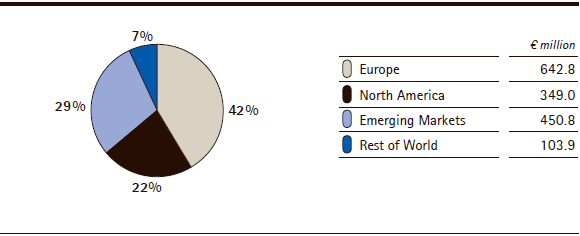
Growth in North America was predominantly driven by Rebif® while the Emerging Markets benefited the most from a continued strong performance of the CardioMetabolic Care & General Medicine business unit as well as the fertility business. In the Rest of World, the biggest single growth driver was Erbitux®.
| XLS |
|
Merck Serono | Growth components by region – Q2 2012 | |||||
|
|
|
|
|
|
|
|
|
|
|
|
|
|
|
€ million/change in % |
Sales |
Organic |
Exchange rate effects |
Acquisitions/ |
Reported |
|
Europe |
642.8 |
–2.4% |
0.2% |
– |
–2.1% |
|
North America |
349.0 |
21.2% |
14.0% |
– |
35.2% |
|
Emerging Markets |
450.8 |
10.2% |
3.8% |
– |
14.0% |
|
Rest of World |
103.9 |
15.0% |
7.3% |
– |
22.2% |
On a product level, global sales of Merck’s largest single product, Rebif®, for the treatment of relapsing forms of multiple sclerosis, rose 9.6% organically to € 492 million (Q2 2011: € 423 million). The increase was mainly due to two price increases in the United States in January and May 2012. In Europe, sales remained stable despite increasing competition and government pricing pressure. Sales in the Emerging Markets declined compared to the same period in the previous year. However, the combined sales from the Emerging Markets and Rest of World are less than 10% of this product’s global sales.
Sales of the biologic cancer drug Erbitux® increased 7.1% on an organic basis to € 226 million (Q2 2011: €204 million). While the performance in Europe remained stable, higher sales in the Emerging Markets drove growth. Erbitux®’s performance in the Rest of World segment benefited from strong performance in Australia due to incipient reimbursement. The organic sales growth of Erbitux® in Japan was 4.8% in the second quarter of 2012, which marked an improvement from the recent softer trend, although this growth compared to a low base in last year’s second quarter.
On July 5, 2012, Merck announced the outcome of the EXPAND trial, which assessed Erbitux® in combination with cisplatin and capecitabine as a first-line treatment for patients with advanced gastric cancer. The Phase III trial did not meet its primary endpoint of extending the length of time that patients live without their disease getting worse (progression-free survival, PFS). On May 9, 2012, Merck announced that the pre-specified interim analysis of an independent study (PETACC-8) did not support the use of Erbitux® for the adjuvant treatment of stage III colon cancer after complete surgical removal of the primary tumor. While more detailed results from these two trials will be submitted for presentation at upcoming international scientific meetings, Merck will not pursue further development of Erbitux® in these two indications. However, these results do not alter the current utility of Erbitux® in patients with KRAS wild-type metastatic colorectal cancer and in patients with locally advanced or recurrent and/or metastatic squamous cell carcinoma of the head and neck (SCCHN) in those markets where Erbitux® is currently registered in these indications.
In late June 2012 the Japanese Ministry of Health, Labour and Welfare granted priority review status to Merck Serono’s submission of Erbitux® for the treatment of patients with locally advanced SCCHN in combination with radiotherapy and in patients with recurrent and/or metastatic SCCHN in combination with platinum based chemotherapy. In China, the review of the SCCHN submission filed in the last quarter of 2011 is currently ongoing.
Merck is still in discussions with the European Medicines Agency (EMA) regarding its application for approval of Erbitux® as a potential treatment for lung cancer.
| XLS |
|
Merck Serono | Major products by region, organic growth rates – Q2 2012 | |||||||
|
|
|
|
|
|
|
|
|
|
|
|
|
|
|
|
|
|
|
|
|
Total |
Europe |
North America |
Emerging Markets |
Rest of World |
Change |
|
Rebif® |
€ million |
492.3 |
188.2 |
258.5 |
35.5 |
10.1 |
16.3% |
|
|
organic growth in % |
9.6% |
–0.4% |
22.0% |
–10.1% |
59.9% |
|
|
|
% of Sales |
100% |
38% |
53% |
7% |
2% |
|
|
Erbitux® |
€ million |
225.7 |
124.6 |
– |
62.1 |
39.1 |
10.7% |
|
|
organic growth in % |
7.1% |
–1.0% |
– |
15.9% |
28.5% |
|
|
|
% of Sales |
100% |
55% |
– |
28% |
17% |
|
Merck Serono | Organic sales growth by key product – Q2 2012
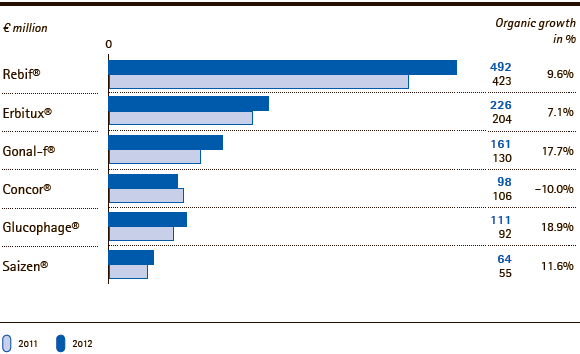
Sales of Gonal-f®, a recombinant hormone used in the treatment of infertility, continued to perform strongly, growing 17.7% organically in the second quarter of 2012, with all geographic regions contributing to this growth. Demand continued to be exceptionally strong in China as well as in the United States, where higher volumes were further boosted by pricing gains. In Europe, the introduction of a family of ready-to-use injection pens last year helped to increase volumes and market share, with sales growing organically by 7.1%.
The division’s Endocrinology business also continued its robust performance, with sales growing in all regions to € 103 million for the second quarter of 2012 (Q2 2011: € 83 million). Sales of the hormone Saizen® for the treatment of growth-hormone deficiency were € 64 million (Q2 2011: € 55 million), up 11.6% organically, driven by higher volumes in the Emerging Markets and price increases in the United States. Kuvan®, for the treatment of hyperphenylalaninemia, a metabolic disorder, continues to grow rapidly in Europe while the rollout in Asia and Latin America remains ongoing. Finally, Egrifta®, used for the reduction of excess abdominal fat in HIV-infected patiens with lipodystrophy and which Merck Serono markets only in the United States, posted a strong double-digit increase in sales.
Sales of Merck Serono’s CardioMetabolic Care & General Medicine products declined 1.7% organically to € 510 million (Q2 2011: € 511 million), mainly due to a weak performance of the beta-blocker products Concor® as well as the General Medicine portfolio. Concor® declined 10.0% organically due to sharp pricing pressure in Europe and increasing pressure on physicians to prescribe cheaper medications. However, the Glucophage® franchise of oral antidiabetic products was the third-largest growth contributor to Merck Serono’s second quarter performance. This was aided by strong sales in the Emerging Markets, particularly Latin America, where Merck is a leading provider of antidiabetic agents.
Half-Year 2012 Performance
During the first half of 2012, the division’s total revenues climbed 8.1% to € 3,144 million (H1 2011: € 2,907 million). Sales for the division similarly increased 8.1% to € 2,964 million (H1 2011: € 2,740 million). This performance reflected organic sales growth of 5.4% and a benefit from foreign exchange rate movements of 2.7%, mainly due to the stronger US$. Main contributors to the good organic performance were increasing sales in the Emerging Markets, led by the division’s Cardiometabolic Care & General Medicine products and the Fertility franchise. In the United States, sales growth was primarily driven by Rebif® and price increases implemented for this product. Business in Europe continued to be challenging throughout this year’s first half due to ongoing pricing pressure as a result of austerity measures and tighter budget control in various European healthcare systems. The division’s EBITDA pre one-time items in the first six months of 2012 increased 8.5% to € 833 million (H1 2011: € 768 million) driven by organic sales growth and currency benefits, resulting in a margin (as a percentage of sales) of 28.1% (H1 2011: 28.0%).
Merck Serono Pipeline News in Q2 2012
In the division’s therapeutic area of Oncology, results from a randomized Phase II study investigating TH-302 in the first-line treatment of pancreatic cancer were presented at the American Association of Cancer Research 2012 Annual Meeting in Chicago on April 2, 2012. This study met its primary endpoint demonstrating a statistically significant (p=0.005) increase in median progression-free survival (PFS) to 5.6 months from 3.6 months in patients with advanced pancreatic cancer treated with gemcitabine in combination with TH-302 (at a dose of 240 mg/m2 or a dose 340 mg/m2) compared to gemcitabine alone. Discussions are ongoing with regulatory authorities and oncology scientific advisors concerning plans to advance TH-302 into a Phase III study in pancreatic cancer. Furthermore, pimasertib, an MEK inhibitor, was moved into Phase II in pancreatic cancer (first-line therapy in combination with gemcitabine). The division anticipates recruitment of the first patients in this year’s third quarter.
In the Neurodegenerative Diseases pipeline, top-line data were announced for ONO-4641, a sphingosine-1-phosphate (S1P) receptor modulator being investigated for the treatment of relapsing-remitting multiple sclerosis. In the DreaMS study, 407 patients were randomized to receive placebo or one of three active doses of ONO-4641 once daily for 26 weeks. Results were presented at the American Academy of Neurology’s 64th Annual Meeting in New Orleans (April 25, 2012), demonstrating that patients taking 0.05, 0.10, or 0.15 mg of ONO-4641 had 82%, 92% and 77% fewer Gd-enhancing brain lesions (measured on MRI), respectively, compared to placebo. Adverse events appeared to be generally dose related and did not require ONO-4641 discontinuation. Merck Serono is currently generating further comprehensive clinical and non-clinical data of ONO-4641 (e. g. cardiac safety and pharmacokinetic efficacy modeling at a broader dose range). Evaluation of these further additional datasets will provide more information on efficacy, safety and potential for differentiation and provide a solid basis for the decision whether this drug is moved into Phase III development in 2013.
 back
back
